



NOTE: What you are about to read is something I never finished, but given that today, May 24th 2019 is the one year anniversary of TotalBiscuit’s Death, I thought it would be fitting to at least show you what I began to work on in the months following his passing.
Someone made a documentary, actually.

^^ This is much better. Go and watch it.
I didn’t want to have to write this piece. Then on July 10th (2018) a Forbes article came out that absolutely disrespected the legacy of a man who was a large part of the gaming community and industry. It wasn’t a simple drive-by hit-piece. No. Rather, it was an in-depth acidic assault that aimed to rot the foundation of this man’s decade long history of passionate work.
That man’s name is Totalbiscuit. Rather, that was his internet moniker. He was a big Terry Pratchett fan.
According to this passage from Pratchett’s 1998 novel Carpe Jugulum:
“Well, we did once have a king called My God He’s Heavy the First,” said Nanny. “And the beer’s been on for the last couple of hours so, basic’ly, you’ll get a cheer whatever you say.”
“Besides, thought Agnes, I know for a fact there’s people out there called Syphilidae Wilson and Yodel Lightley and Total Biscuit.”
All I know for sure is that I’ve seen Totalbiscuit’s career play out first-hand. Since at least 2011. I’m an eyewitness to a reality that’s being brushed under a rug of lies and smears about his life’s work.
It’s something that I intend to fix. John Bain fought his entire life to help consumers get a fair shake. The least one can do in return is give him that same opportunity. Human decency and respect didn’t die with Totalbiscuit, no matter what the media vultures picking at his corpse think otherwise. The pursuit for personal dignity is just as alive as he was.
So. I’m going to give telling the story of Totalbiscuit a fair shake. It won’t be sugar coated. But it will be the honest reflection of life he deserves. Totalbiscuit liked dogs. He liked metal. He liked wrestling. People loved him and believe it or not John Bain loved people too. But with YouTube fame that came at a cost. He made sure to distinguish the fine line between viewers and friends.
Totalbiscuit saw the internet Wild West age end, and tried his best to guide the gaming community through the turbulence of today’s times.
It began with a question.


To introduce when exactly Totalbiscuit got started on his career path, I’ll him tell that story himself.
“The precise moment that started me on this path. I was in the car with my dad. In Middlestone Moor. I heard a Live365 ad on the radio. ‘Be your own DJ, make your own internet radio station!’ it said. ‘I want to do that,’ I said. ‘I wont cost us anything right?’ Dad said. The RIAA effectively obliterated Live365 couple of years later so we went the pirate route, but thats what started everything.”
So while John Bain was around 16 to 18 years old at the time, Totalbiscuit was born in an old silver Ford Mondeo estate. But before we’d see him grace the airwaves of YouTube, TB went from “pirate icecast radio,” into student radio, and then onto online talk radio.
The first thing he wanted to bring to the airwaves was metal.
“Got my start on student radio with a last minute demo tape that featured Nightwish and Mr Bungle. Mike Pattons divine intervention,” TB said.
As far as it seems, this student radio gig lasted from roughly 2001 to 2003. It was at some place called DemonFM, a community & student radio station in Leicester. WoWRadio got set up in 2004. It was based somewhere in the US. At some point toward the end of that year. TotalBiscuit was the owner of it, overseeing staff members. One of his tasks was getting sponsors. TB says this was possible with his audience of 500 listeners. WowRadio closed up shop at the end of January 2011. Bain transitioned over to CynicalBrit by this point. One of the most important things to note here is that the radio days are where Totalbiscuit got his signature voice from. Of course. But TB’s transition was necessary because “WoW Radio was a bloated, expensive mess, Cynbrit isn’t.”
Ex-staff members complained that it was TB’s fault that WoWRadio failed. He didn’t take that sort of thing personally though and was more than happy to help out his old staff if they needed it.
I wanted to know what it was like being in the trenches with Bain back then. So I interviewed
WoW Radio was never as successful as Cynical Brit was, but it was also certainly self-sustaining with little to no support from WoW Radio’s leadership, or at least, I was never asked to provide resources to the financial stability of WoW Radio. After Blizzcon 2009, I was called into a meeting with TB and Eriyana and the tone of the meeting was that TB was done trying to lead WoW Radio with some number of staff that was trying to undermine his leadership. I don’t know the details beyond there being a faction of staff that tried to take control of the station during Blizzcon. Both Hordak and I were pretty aloof from the rest of the staff by that point, so I can’t tell you exactly who was who.
YouTube Uprising
Let us make it clear. Totalbiscuit talked about PC games, and not console games.
The first video on the TotalHalibut YouTube channel (what would become TB’s main workspace) was uploaded on July 29th 2008. The contents of the video itself are actually two years older, though. It takes us back to 2006 when a 21-year-old John Bain gave a talk about World of Warcraft and video game addiction. Much of the Totalbiscuit we all know is present there, over a decade ago in an Arizona lecture hall. The energetic snark coupled with genuine enthusiasm for gaming. Classic TB mannerisms are peppered throughout. The guy was analytical and openly embraced nuance. He had a signature disdain for moral panic in society. On top of it all it looked like he was giving this speech from memory alone. The audience is deeply involved in what’s going on. They’re entertained, interested, and have their attention visibly invested in what TB is talking about. Skip to the end of the video where there is a Q&A session to see this for yourself.
You’ll notice something with the participating audience members who come forward to ask Totalbiscuit questions. They feel comfortable and confident with challenging him. People don’t lob softball questions at TB, but instead give hard-hitters. He didn’t shrug off in his responses either. Instead, managing to fire back with something as equally formidable. Not everyone agreed with Totalbiscuit either. There was at least one prominent skeptic in the audience. But TB treated them with the same level respect as everyone else.
John Bain knew how to start a conversation. At the end of the video, the possibility of starting a “guild” in order to combat the mass media narrative about video game addiction is brought up. As Totalbiscuit heaps praise about the social aspect of gaming, his appreciation for the power of friendship gradually comes into focus. It peaks at the point in his lecture when mentioning how even if our world can easily end up torn apart by war, that in the midst of all the darkness and ruin the concept of friendship would survive. Bain refers to friendship as one of the few, real enduring qualities about our society.
Little did he know that his viewpoint would be viciously tested throughout the course of his YouTube career.
By May 9th 2011, Totalbiscuit passed the 100,000,000 views milestone for his YouTube channel.
To give you a sense of perspective. Totalbiscuit’s YouTube channel hit 10,000 subscribers on July 5th 2010. From there he just climbed and climbed. By January 2011 he was up to 217,000. Hitting the arbitrary milestone of 250,000 on March 2nd 2011. Soaring and soaring upwards in the months afterward. The 500,000 subscriber milestone came in October 2011. By June 2012, the arbitrary nature of subscriber numbers began settling in. But make no mistake. Thinking of numbers as arbitrary doesn’t mean TB wasn’t proud of them all. He was. 750,000 by August 2012. Milestone after milestone.
All of a sudden here he was. Sitting at the big 1,000,000 subscriber mark on March 14th 2013. After that the whole milestone thing seems kinda silly. The plaque is nice though. According to Socialblade he peaked at 2.28 million on June 27th 2016.
His flagship series? WTF Is.

WTF Is
The first one. On September 14th, 2010 Totalbiscuit uploaded a pilot episode to what would go on to be one of the key pillars of his YouTube career. It was titled “WTF Is… – R.U.S.E.?,” taking viewers through the ins and outs of some military strategy game.
His booming voice commands your attention and carries TB from start to finish.
The most important thing Bain was doing here? Playing the video game. This wasn’t just a “Let’s Play” (a genre of YouTube content which you are no doubt familiar with). TB went the extra mile when showcasing game-play mechanics, going as far as he possibly could to play out the intended experience promised by a particular product. Not content with simply sitting in silence while playing a game, TB used his voice to his advantage and narrated what was happening. So now viewers not only got a chance to see the game, but they also got insight from Bain himself to make sense of that. In the case of R.U.S.E. he educated viewers on quality-of-play facts like the responsiveness of the PC version. This seemingly niche bit of information makes a difference to the consumer, as in the world of video games when there’s PC and console versions they might not be exactly the same product throughout the both of them.
With all that said. When Bain asked the simple question of “WTF is R.U.S.E.?,” he provided an answer to that. R.U.S.E. is a reference to the game’s signature strategy which grants players the ability to deploy imitation units that launch a fake assault on their opponent.
Thus. The question was answered.
[MENTION HOW WTF IS PROGRESSED THROUGHOUT THE YEARS (what changed, plus trivia facts)]
Here’s what FUN creators, the game developers of Guise of the Wolf, emailed Totalbiscuit’s team. If you think it was a one-time thing, when it comes to sending “colorful” emails like that? Nope. Their follow-up was the same level of (un)professionalism. It didn’t just happen in private, either. It was a public brawl. TB had to make it one because the company denied taking down their YouTube videos. They went as far as to accuse Totalbiscuit’s staff of photoshopping these messages, so they had to make a video proving otherwise.
It’s a situation where TB showed a lot of Twitter restraint in circumstances which could’ve easily provoked otherwise.


I won’t just tell you the impact WTF Is had on the gaming industry. I can show you, too. March 7th 2014. Totalbiscuit does a video on One Finger Death Punch. Here’s what the game’s developers said had resulted thanks to Bain spotlighting their product.


The Framerate police.
— “I also do like that he was one of the few reviewers that took the hardware and price into consideration which are big decision factors”
— This video is no longer available: The Day One Garry’s Incident Incident
— Make a note about Warframe
— “WTF is.. Brothers: A Tale of Two Sons. TotalBiscuit- “in 25 years of gaming i don’t think i’ve ever had an experience which has matched up to brothers”” http://archive.is/14hee
TotalBiscuit loved Brothers: A Tale of Two Sons so much that he gave away game keys for Christmas that year.


Fans of Totalbiscuit say the best example of TB being truly happy in his element as a critic was when DOOM by ID Software and Bethesda Softworks came out in May 2016. He made a 20 minute video specifically with the intent of gushing over the game’s well crafted campaign mode. It becomes clear that Bain was surprised at how everything in DOOM was harmoniously in sync. Especially with regarding to the pacing of action (the “shocking” movement speed carrying the player into it within seconds of starting the game). TB says he felt a similar sensation back in 2014 when Bethesda’s Wolfenstein: The New Order came out. But here with DOOM, the consistent spawn rate of demons in light of the modest difficulty mode, the plethora of secrets throughout that encouraged Bain to replay levels, and the weapon upgrade options that delightfully reward the player’s combat abilities. Most noticeably, TB was blown away by the glory kill system implementation. Not only were the animations short enough to avoid being detrimental, the generous amount of health awarded for performing them maintains DOOM‘s pacing. He loved that the atmosphere wasn’t too serious and how that was made perfectly clear in the main character’s “not giving a fuck” attitude.
“God I can’t wait to play the rest of this. This is great!” John Bain was a kid in a candy store with DOOM.
Of course there were times TB clashed with the audience’s opinions on games. Like Titanfall 2. Mass Effect Andromeda takes the title when it comes to the longest “WTF Is…,” according to Bain.
The last one. On February 16th, 2018 Totalbiscuit uploaded what would be the final episode of WTF Is… in his YouTube career. It was titled “WTF is… Octogeddon ?” taking viewers through the ins and outs of some cartoon octopus rampage game.
His once booming voice is now noticeably wounded, but TB carries it from start to finish.
Even in his final months, Bain still found the energy to slam Octogeddon’s lack of an options menu. In this final entry into his series TB followed through as intended with giving the viewer an intimate sense of what to expect when playing. Despite this it’s still heartbreaking to watch Totalbiscuit’s video here. Which is unexpected when you see a cartoon octopus flailing around underwater shooting weapons at oncoming enemies. But when I think about it a bit, I realize the sentimentality of this comes from the fact that TB was able to present something goofy and far-fetched in a completely dead-pan serious manner.
A little over halfway through (around the 11 minute mark), TB lets his octopus character die on purpose. He openly welcomes death as a good thing here because it would allow him to show us more features of the game. You can make all sorts of symbolic comparisons from this, but I’m not going to do that. It’s just hard to swallow hearing “ARGH I THINK IM GOING TO DIE” in Totalbiscuit’s final WTF Is… episode.
There’s always the question of what to label TB as. Was he a journalist? A critic? A gaming commentator (at least that’s what his business cards said)?
What we can say for certain is that no matter what Totalbiscuit was, he made sure to be as transparent as humanly possible about it. Wasn’t even afraid to show viewers his channel analytics. Which in the end is a valuable insight to his audience. It’s rare for the public to get an opportunity to see the significance and impact of social media platforms like Reddit.
This short essay that TotalBiscuit wrote earlier on in his YouTube career best exemplifies the behavior dynamic between content creators and the community. That, on top of TB’s personal views and roles in such a relationship. On the one end, TB harkens back to the self-defeating cycle in which the response to toxicity is “Reddit isn’t one person!”, while all the meanwhile encouraging a further pile-on of negative behaviours.
“Members of Reddit, TL or other similar sites make the claim that they are not all one whole that the actions of a few do not represent them all, yet they are always so defensive about the whole thing, acting as a collective pack in defense of the hive, which puts out a pretty confusing message. Yeah you’re right, you’re not all one person, Reddit or TL etc. is not just one collective voice, so why are you so upset? I mean we’d have to be idiots to assume that it’s all one voice coming from there, so surely you can see that when we say “Reddit” we mean “those vocal minority dicks on Reddit”, right? Well apparently not, because this goes the same way every time and always exposes even more venomous attitudes.”
He says that the “old boys” cabal of prominent people in online communities like his only seek to do their job to the best of their ability and make sure everyone has a good time. But the tension between community and creator is rooted in the bile nastiness that spouts forth from the “nobsacks” who decide to shit on a creator’s career.
TB ended his post by reminding the reader that there’s real people behind every keyboard. When it comes to Bain’s struggles with social media and feedback, that’s exactly what we’ll see on display.

Cancer
Folks reading have likely seen the infamous “get cancer and die” tweet from Totalbiscuit. Many see it as “hella ironic” that John Bain himself ended up getting cancer and dying after tweeting that exact thing to people (twice).
Any shmuck on the internet can point the above facts out, call it “poetry” or something like that, and move on to something else. What hasn’t been said or looked at yet is all that “in-between stuff.” The journey from A to B that Totalbiscuit went on in coming to terms with his cancer.
In fact, most people don’t even do the decency of mentioning Totalbiscuit’s acknowledgement of the “get cancer and die” fiasco. He wrote a May 2014 Twitlonger addressing it and giving context on where his life was at the time TB said what he did.
In 2011, Totalbiscuit was in the midst of digging himself out of a ditch his government put him in. The UK immigration authority fucked him. Not just in the standard fashion either. They royally screwed him over by making the years of struggling Bain went through to see his wife and kid be for naught. It was a three-year trek to this middle finger the UK government gave him. After being booted from the USA in 2008, sacrificing the independence of his youth by moving back to his mom and dad’s, then financially tredding water on a teeter-totter of making day to day ends meet.
John Bain was running on the carrot-and-stick treadmill of “the system.” He was hoping to save enough funds to afford a lawyer to take care of his visa problems. But Bain’s job at the time didn’t sufficiently pay for that opportunity to be feasible. It was only through the miracle of YouTube success (and the money within), that TB broke this cycle.
Totalbiscuit broke free of his circumstances and started getting a wife/kid visit in motion. Only to have that STONEWALLED. Bada-bing. Bada-screwed. A recipe for disaster that boiled over on Bain’s Twitter feed.

With that context taken into consideration, the “get cancer and die” tweet is seen in a different light. Bain didn’t say that out of malice toward @Seanza. It came from the place where love and anger meet up together inside someone’s soul to hang out (alluded to by TB himself during that rage storm). As you can see, the tweet certainly wasn’t personal. He lashed out at several different people that day. Nearly all of it still there on his Twitter feed, all these years later (minus “get cancer and die” which was deleted).
It was an incident Bain could’ve buried that day in 2011. Never looking back at it again. But in May 2014 Totalbiscuit chose to atone for his mistakes instead. He made it clear that apologies to the folks involved were made (making one to @Seanza in particular in May 2013).
Back in that Twitlonger, TB finds himself asking one not-so-simple question that he (nor anyone) has an answer to:
“The internet is weird and we are the first people have to deal with the idea that everything we do could potentially come back to haunt us and that there is no such thing as a delete button. In time I’m sure we’ll come to understand how best to handle that, but as it stands most of us are just stumbling in the dark.”


Are Traps Gay? ShortFatOtaku presented the most circulated argument at that time. He laid out the distinction in lifestyle choice between transgender people and cross-dressers.
Unfortunately people who were around during GamerGate took this CoxCon situation as some sort of betrayal. The gaming community et al thought it was hypocritical for Totalbiscuit to slam his own audience. It’s certainly an odd way for John Bain’s online career to culminate. A fan convention debacle that left a sour taste in the mouths of all parties involved. Laura Kate Dale wasn’t afraid to give it a solid “fuck you,” despite eventually claiming they were aware of the broader context with the phrase itself.
But in Dale’s recollection of the incident, that context awareness is brought into question. “Short version – They were asking if a man attracted to trans women is gay (the implication being the trans woman is really a man),” tweeted Laura.
Therein laying out the heart of the problem at hand.
Totalbiscuit kicked things off by tweeting the person who made the joke was IDed and removed from the event. “We will not tolerate that bullshit in our event, ever.” TB followed up by donating the cost of the ejected ticket to the Albert Kennedy Trust (who focus on transgender issues). Throughout the day of July 22nd, Bain threw around terms like “edgelords” and “flaccid trolling” when describing the situation itself and public reaction.
In the waves of social media reaction that kicked up once the CoxCon fiasco hit, there was an old tweet from TB that bubbled back to the surface.


Indeed. People online thought it was apt to compare the one-on-one Twitter conversation between two friends (an apple), to a stranger cracking a joke in his opportunity to ask a question from a group panel during a convention in front of a real-life audience (an orange).
It’s worth providing an official explanation as to what the circumstances surrounding the CoxCon incident were, from the team’s point of view:
“TB didnt make the decision alone. This is one of many falsehoods being thrown around. The decision was made by the Coxcon staff and panelists as a group. We have been told that there were no non-staff involved in any of the decision making process. That includes Laura K, who is not a staff member or panelist at Coxcon, just a regular attendee. This is another rumor that has been spread by various trolling groups and has cropped up on this subreddit as well. The moderation team has been told in no uncertain terms that this is completely false. A meeting took place in the Coxcon staff and ops rooms, which are not accessible to anyone in the venue who is not a staff member or invited panelist. Laura K was nowhere near there at the time, didnt have access to those rooms and in fact was photographed at the time the decision was being made on the opposite side of the venue.
The decision was made with full knowledge that the remarks made by the attendee were a meme and their connotations. It was also done after reviewing the tape of what had happened along with eye witness accounts of staff members that were in the panel room at the time. Despite a few nervous laughs, the panel room was genuinely uncomfortable during that segment at the atmosphere noticeably soured. There is a clip floating around that some are claiming shows the audience found it funny, but as you can see if you watch any of the VoDs, Coxcon is a VERY loud crowd and compared to any of the moments that the crowd genuinely found funny, this is a small number of people nervously laughing while everyone else cringed. The panel room at Coxcon was frequently full and holds over 1000 people. It was full during the opening panel. 1000 people laughing is orders of magnitude louder than the laughter in the clip.”
TotalBiscuit did not make the decision alone.
Yet how it looked at the time, I still thought TB lost his marbles on this one. Despite having somewhat of an understanding as to his motives, it still would’ve made more sense to handle it differently than it had been. But without a doubt it goes to show John Bain was loyal to his friends. In retrospect, the CoxCon incident is also perfect in summing up what Totalbiscuit really stood for. In his good, bad, and ugly moments.
The fact that people were disappointed in the first place with Totalbiscuit here, demonstrates the high regard his audience and the public had for him as a person. John Bain didn’t build his YouTube empire on a foundation of lies. Instead he kept himself honest. However the definition of that may have seemed to play out on a situational basis. If you’re thinking to yourself of a time Totalbiscuit lied? Chances are he was the one to tell you about that lie. Bain acknowledged his personal shortcomings. I bet you can rattle off a dozen different YouTube channels that have had their fair share of past shady dealings. Folks who create an atmosphere of doubt to their legitimacy. But with Totalbiscuit? That doubt was replaced with a sense of confidence. You were left assured that John Bain was being straightforward with you. Every single time.
But there was a cost of Totalbiscuit’s record of transparency. That being the fact that the real world isn’t always neat and orderly. Sometimes things happen that just don’t make sense. TB had to cope with that, and deal with the hand life gave him. The cost of being honest in an imperfect world is that at some point from the outsider’s perspective, expectations don’t match up with how events played out.
Doesn’t it sound tempting to just give into that lie? To sacrifice your personal values for the sake of keeping up appearances? Back during the 2016 election season, Bain admitted to drinking out of that cup. It was clear he did not like the taste of it. To TB, the sweet little lies we sip ourselves every day was a bitter and noxious concoction. Life is an emotional experience, too. We’re not machines. If you expect someone to be honest in respect to that, you’ll get the full spectrum of emotion. No matter how many years go into tightly controlling and taming that aspect of human nature, at the end of the day a human is still there.
That’s precisely what swings us back around to TotalBiscuit’s principles. He was fiercely loyal to his friends and colleagues.
He’d soon face a difficult test of this exact nature.


A little over a month later, everything would go to shit for TotalBiscuit’s friendship with Laura Dale. It all started on August 16th 2017. Laura Dale releases “TotalBiscuit on Dealing with the Hate” on Kotaku’s UK branch site. It’s a very mundane and straightforward interview which explores the harassment experience by him and around him online. There were absolutely no jabs or attacks at other people personally. In fact the interview is diligent in staying within the boundaries of reflection to being TotalBiscuit personally. GamerGate was never mentioned by name.
Everything went bad when FemFreq showed up to tweet. “Outrageous & irresponsible of Kotaku UK to post this puff-piece on a Gamergater on the hate movement’s anniversary.” She piled on another. ” You know what? Both sides were there. Nazis and anti-Nazis. What’s your side?”
Opps! Anita apparently went too far because their last tweet on the topic was “you can strongly disagree with & condemn something that someone says or does on the internet, but doxxing a marginalized person is never OK.”
Bain had one hell of a response to give Anita.
“Alright Anita, I’ve ignored you for 3 years and your fade to obscurity is delayed by me acknowledging your existence, but you’re a hack. Anyone who tells people NOT to read an anti-harassment article with advice on how to combat harassment, is not anti-harassment. As if we didn’t already know. Anita is interested in one thing, milking as much from this industry as possible intellectual dishonesty. She along with her allies have poisoned reasonable discourse for years on the topic of representation in games. @femfreq supports harassment. So come at me. You stand shoulder to shoulder with 4chan trolls and bigots in attacking the loud, sane voice in the room. You cannot win. When you and your cronies attacked a transgender journalist for trying to combat harassment, you revealed you are only in it for yourself.”
In the end, TB had to let go of the very person he was adamant in standing for.


In the end, I’d argue that the countless number of people positively impacted by John “Totalbiscuit” Bain will always outweigh the negativity he had to contend with.
“It was so much easier to blame it on Them. It was bleakly depressing to think that They were Us. If it was Them, then nothing was anyone’s fault. If it was us, what did that make Me? After all, I’m one of Us. I must be. I’ve certainly never thought of myself as one of Them. No one ever thinks of themselves as one of Them. We’re always one of Us. It’s Them that do the bad things.” ― Terry Pratchett, Jingo
Back on January 12th 2012, John Bain first introduced the TGS podcast as his return to podcasting. He was nervous back then. “This’ll be the first video podcast I’ve ever produced live. No safety nets, always wonderful to get the adrenaline pumping,” TB tweeted.
TheGameStation/Co-Optional podcast ended up becoming TotalBiscuit’s mainstay, even surpassing his WTF Is series in some aspects. He made it clear that the podcast was the highest earning show on his YouTube channel. It was on other platforms too; putting the podcast on iTunes accounted for twenty percent of the overall audience.
When it came to the guests, TB used to be real strict. Keeping things in-house to TheGameStation network members only. But over time those limitations loosened up and he really went full throttle with variety. TotalBiscuit wasn’t afraid to spice things up in both the types of people he invited or what their particular beliefs were. It took time, but TB learned to give the guests leeway too in the sense that they might not immediately gel with himself, Dodger, and Jesse Cox.
TB kept an ear close to his audience when it came to feedback. He cared very deeply about improving the show as much as possible.
It was an international sensation. I can call it that because TB revealed the market spread for the podcast. USA/Canada, UK, Western Europe, and then South America. In that order was the magnitude of geographical popularity the podcast acquired. The YouTube views the Co-Optional podcast brought in during its heyday was anywhere from 300,000 to 450,000 on average. YouTube rewarded long form content and TB was able to jump on that bandwagon early on. TotalBiscuit cared about that. The views. He was meticulous in trying to optimize the output. When they talked about video games, at least a small portion of the audience was guaranteed to check out those particular ones too.

TGS/Co-optional Podcast
TB often played video game music during the break. He liked promoting composers and bands in that sphere.
The TGS podcast saga began with the first episode. Uploaded to YouTube on January 22nd 2012. From the title alone, “TGS Podcast – #1 ft Gunns4Hire, hosted by TotalBiscuit, Dodger & Jesse!” you’d see nothing out of the ordinary.
But it was definitely something that’d be out of this world.
The first TGS podcast started out with laughter immedately. You’d expect as much from people who were nervous. Now for most of you, the most standout quality of the first episode would be the screens being obviously smaller for each of the four hosts. It’d be something TB would tinker with as time went on. But as is, things started off as an “absolute disaster.” But Bain stood proudly by that disaster, with a British Union Jack flag waving behind him. The podcast was more of a jury-rigged experiment of sorts, more than anything at this point. It gave TB reason to invest in a second monitor. Jesse Cox started off the TGS podcast with a joke. That’s what he brought to the table, being the funny one. Dodger was the cute gamer girl personality. TotalBiscuit was the smart one, keeping things on track. Their initial debut had 4 and a half thousand listeners on Twitch. The show would also be posted onto iTunes and YouTube too, for maximum reach. As it stood, the show had four members of the TheGameStation (TGS) network *strictly.* This was designed as a means of spotlighting different members of the TGS network, from the get go. One of the show’s initial segments was everyone picking a video from a TGS channel to highlight as their favorite, in an encouragement for the viewers to check it out for themselves. Elsewhere, the show’s agenda included things like discussing the latest game releases, and each of the hosts bringing a topic to discuss. TB didn’t. But he had a good excuse. He spent all day beforehand getting this podcast set up. There’d be music breaks too. Echoing an element of TotalBiscuit’s WOWRadio days, TB routinely picked video game music and soundtracks from indie artists and that sort of fan community that formed around particular titles.
But first off on the show, there was the discussion surrounding the video games everyone had played that week. TB called out Jesse Cox’s response to this immediately. The hodge-podge of Minecraft, Skyrim, World of Warcraft, Deus Ex, and Star Wars stuff was what Cox was doing for *work.* TB wanted to know what Jesse was playing for *fun.* On one hand, Jesse was willing to admit to some laziness. But on the other, Let’s Plays on YouTube were a popular thing. This led to a general discussion surrounding what made a “quality playthrough” versus the rest of the garbage on the YouTube website. Jesse and TB’s Terraria playthrough came up inevitably. It’s funny seeing the tip-toeing had around “are we allowed to swear?” on the podcast. TB gave it the thumbs-up and it ended up being something they’d all become much more accustomed to doing. The show’s debut guest, Gunns4Hire, was playing Minecraft. He had genuine fun in an unscripted sort of exploratory playthrough on his own channel. The Let’s Play scene was flooded with Call of Duty commentary at that time, though. TB was openly curious about the standards of judgement involved in that sort of scene. It became a conversation surrounding tactics/skills vs. the entertainment dynamic involved in multiplayer gameplay. Dodger chimed in by stating she was enjoying Ultimate Marvel vs Capcom 3. She got this new fightstick/joystick thing-a-ma-jig and was breaking it in. She noted that it was a speed and button masher experience, whereas other titles like Street Fighter IV required a more tactical approach to gameplay.
The general pattern was TB talked to Jesse Cox. TB talked to GUNs. TB talked to Dodger. It was a dilemma that’d naturally iron itself out as the podcast series went along, but from the get-go it was clear TotalBiscuit had this higher authority over the rest. In the middle of the super serious discussion everyone was having about fighting game joysticks, Jesse Cox made a quip mocking TB and did a voice imitating how dedicated he sounded about the subject.
TB himself was in the middle of a Shogun 2: Total War addiction. In particular he had a clutch strategy battling the AI using in-game ships to his advantage. Sinking said ships, to be more precise. There were ship jokes made, alluding to penises. But also serious discussion about things like terrible AI. Dodger asked question about that, and TB was happy to answer. TotalBiscuit seemed to have an encyclopedia of gaming knowledge from the get-go of the TGS podcast. Which made it work. When the conversation shifted to Dynasty Warriors, TB was able to pull out that particular tome from his mind’s library and regale everyone with his own thoughts and feedback.
After they came back from the break, the debut of the news portion of the show happened. The first piece was about a controversial statement put out by Namco Bandai. Specifically, something said by the senior VP for their Europe division. “Free-to-play games can’t be high quality,” said Olivier Comte. He pointed toward the business model as the vehicle that precluded that from happening. “We need to put certain value on certain work,” Comte added. “When you’re a big company… you can’t take risks too quickly, you can’t make a change just because there’s a fashion for a couple of years; you want to be there in 20 or 30 years.”
TB asked everyone else for their thoughts. Dodger thought Olivier came off as pretentious. TB was surprised that someone from Namco Bandai’s European division said this. His gut instinct in these cases was that Japan would be the ones to say it. Bain proceeds to tell everyone about Japan’s general tendencies in their treatment of the video game industry. Back then in 2012, Capcom hadn’t brought the Monster Hunter series to the US yet. Well, definitely not in any way comparable to how it’s done today. Capcom was tone-deaf in what Western audiences wanted. TB mentions how Monster Hunter 3 was ported to the Wii of all things rather than the two other consoles that were much more capable in handling the graphical fidelity and intensity. Gunns4Hire disagreed completely with Olivier. Free to play could EASILY match AAA expectations. Jesse tore himself away from trying to fix his screen view to throw in his own contribution to the conversation. He pointed out how the Lord of the Rings MMO game went free to play and it turned out to be a company-saving move. TB brings the discussion surrounding free to play back towards the big picture, but in a practical sense that related to what the consumer level experience was. He said time worked as more and more of a bias in terms of personal investment. TB said something to the effect of “people aren’t gonna abandon what they spent years building.”
The podcast derailed a bit from there but it circled back around in time for the second news story. It was about Bioshock Infinite. The developers behind the title announced a harder difficulty was coming, titled “1999 mode.” The discussion around this news story was about the games industry’s renewed focus on challenge and the new perspective it seemed to have toward it. Demon Souls and Dark Souls are used as modern examples (this was YEARS before any further iterations by FromSoftware), in contrast to the definition of difficulty in the sense as it was in the NES era of gaming. TB thought modern easy mode was being molded into a “story mode” or “cinematic mode.”
The podcast derails after TB mentions a website called TV tropes. He admitted to reading it and went over his own list the site labeled him with. Jesse takes the opportunity to advertise “gamer food” nuts he was eating. Cox got them for free in return for promoting the product.
The next segment on the TGS podcast was the trailers. It was something that’d be regular tuned and tweaked as the series went on. Here in the debut episode, TB couldn’t get the Resident Evil 6 trailer working right on his first try. His browser froze and when the video DID finally play, the audio didn’t work. So the gang dubbed over it. But their next trailer for Game of Dwarves actually played fine. The aim of this portion was to play the trailer and for everyone to give impressions afterward. They got it right the second time around. But with the Mass Effect 3 trailer they followed that up with we’re left wondering if they wanted things to work right in the first place. Watching Bioware developers jazz up the lackluster Kinect gimmick for Xbox left a lot to be desired. TB cut the trailer before it even reached the end in fact. It was obvious to everyone that it was Microsoft marketing propaganda. But they gave it a fair shake in their impressions, exploring the reality of Kinect’s gameplay limitations.
The trailers portion of the show was cut from the podcast routine early on in the series. YouTube’s automated content ID/copyright system made it too much of a hassle and burden to bother with. Especially with Nintendo.
They rounded off the show with host topics. Dodger was up first. She chose video game piracy, asking everyone else if the “if it’s good, i’ll buy it” argument was ethical or not. TB’s response to that was people “rationalize away” that possibility of purchase and never do it. Gunns4Hire said the problem shows itself in cases with smaller developers. TB says piracy needed to be thought of as a market force, before then admitting he used to pirate games when he was a school student (he obviously didn’t agree with doing that sort of thing now). Jesse brings up a compelling point eventually. He mentions how piracy allows young people to circumvent the ESRB maturity ratings for games and allow direct access to explicit content. Cox points out how the popularity of Witcher 2 both as a game, and for the lewd content within, created a spike in piracy as interested gamers sought out this mysterious forbidden fruit. Of boobs. TB thought Jesse’s point was perfectly valid. Jesse Cox’s topic was “have MMOs become completely stagnant?” He asked everyone if World of Warcraft was the peak of the genre. Cox was disspirited at the lack of real innovation in titles like Guild Wars 2. He couldn’t shake off the “WoW copy” feeling. Gunns4Hire related to what Cox was feeling. Dodger said developers were always going to continue to try new things, but the WoW format was reliable. TB said World of Warcraft is successful because people are afraid of trying new things and just want to do the happy and familiar. Star Wars: The Old Republic MMO is highlighted as a point of interest to the discussion given how recent its release was. The story of TOR was fantastic but end game content was lackluster in comparison to WoW. TB speculated future video games would have MMO integration built into it gradually (solidly true as of 2018). He made the distinction that whilst MMORPGs WERE becoming stagnant, the MMO in itself wasn’t as much. Gunns4Hire was up last. He talked about the recent shift to mobile gaming and the apparent circlejerking happening within games media back then. Exploring if there was anything to that, TB started by talking about phone companies were just on the cusp of tapping into the technological potential for proper console-like gaming experiences. The interface problems that lay within were negotiable with the right accessories. TB said the preferred future was a single mobile device that could play everything. Jesse disagreed, and Bain then clarified that the big-screen console experience wouldn’t be sacrificed by default. The argument boiled down to the future being platform neutral, over mobile domination.
In the last few minutes, TB and the other hosts wrapped up the show by explaining what they’d be doing on their channels over the next week. It was essentially squeezing that last sweet drop of free promotion out of the podcast. TB questioned the format of the show at the very end. The 2 hours, 52 minutes, and 42 seconds runtime that it ended up being was a far cry from the 90 minutes they originally intended. They ran with that length anyway throughout the years, regardless.
They became friends. The three of them. Fairly fast, all things considered.

A memorable podcast early on was when Felicia Day came to the show. Episode 27 of the TGS podcast, October 5th 2012.
Jesse Cox slowly panned the camera onto him in a nice dress shirt. Felicia Day was on the show as a representative of the Geek and Sundry network. She was confused as Jesse started to play some cheesy jazz music to remind her of their “long and sordid” love affair. Which more or less boils down to meeting at Blizzcon for the first time back at the 2011 event, with Jesse being kicked off a podcast there and replaced by Felicia. Jesse recounted several other times they met since then, until rounding off with this TGS podcast stream where they were “legally obligated” to hang out together. Cox thought he’d seize the moment by lighting candles and eating TimTams. Felicia’s reaction appeared to be genuine bewilderment and shock, when it came to not remembering Jesse Cox on any of these occasions. Yet she’s upfront in telling him that it probably wasn’t the best idea leading off the conversation so…. strongly.
Felicia played Borderlands 2 on PC but wanted to get the Xbox version so she could couch game. Dodger was still playing a lot of Borderlands 2 as well. She remarked the UI seemed more suitable for the console version. TB recommends Steam’s Big Picture mode would suffice on that. In the old days, his approach was much more makeshift. TB got a house with his mates for a year after university. He had the attic with a slanted ceiling. So he got a projector and hooked it up to his computer so he could play games like Battlefield 2 while lying in bed.
Felicia also played Guild Wars 2 and sunk a lot of time into FTL. Felicia thought The Secret World questing system was great, but the combat system held the game back. For a while, TB and Felicia debated about the game’s business model. Jesse brought the conversation around the crafting system in Guild Wars 2. They then debate how close or how far away when it came to cloning features in MMOs. Jesse talks about The Old Republic story and said it was good. Felicia said if it was a Mass Effect universe she’d be more intrigued. Jesse relishes over the World of Warcraft: Mists of Pandaria expansion. Dodger played The Basement Collection. She thought they were weird games from the Super Meat Boy people, especially since they were all unfinished. She was GOING TO play Resident Evil 6, but heard it was bad so she chose not to. Jesse wanted Dodger to finish her Dead Space playthrough so they could make a Dead Space 3 series together (they’d end up doing that eventually).
When it came to bad games, TB said he used to join in on Something Awful trolling for Christmas where they’d send people copies of Bad Rats on Steam. Back then they couldn’t get rid of it.
TB talks about Mechwarrior Online. At that time, it was released in a really rough state so TB couldn’t talk about it for the past four months prior to the podcast. The game ran on CryEngine and had a lot of customization. He thought it was a very barebones game though, with a weird progression system built on top of the free-to-play business model foundation. But cutting limbs off was fun and the game had great sound design. Nevertheless TB found himself more interested in Hawken. Elsewhere he had been playing Bad Piggies on iOS. A spiritual successor to Angry Birds where you build and control vehicles. Felicia ranted about the physics of Angry Birds not making any sense.
In the middle of the show, Cliff Blezinski departed Epic Games. It was such a hot-button topic it made Twitter’s trending page. His departure letter said he needed a break. Felicia harkoned things back to the reaction of Dragon Age staff departures being heated and abusive. She said fans needed more empathy. Then they all talked about the general mob mentality of YouTube comments. Cliffy just got married so they speculated that played into it. Totalbiscuit talks about Fortnite and thought it looked interesting, were dwelling a lot on the crafting/building elements involved. When it came to other news, Steam was starting to non-gaming software on their store. They pointed out the problem with that polluting the new releases section on Steam. Felicia noted Indie Game: The Movie was made available on Steam. Jesse talked about the ownership dynamic of software and how people don’t really own it. The evident reality with everyone downloading video games nowadays, switching to digital over physical. TB questioned what the criteria for software was to get on Steam. It in itself wasn’t clear for games, let alone software.
Releases: Resident Evil 6, War of the Roses (don’t buy it b/c server issues), Hell Yeah! Wrath of the Dead Rabbit, Dishonored (TB was hyping that as game of the year, loved the setting), Fable: The Journey (Felicia destroyed her copy of Fable 3 because she loved the first half and didn’t expect the political twist of the second part), Pokemon Black and White 2, Rocksmith, WRC 3: FIA World Rally Championship, Naughty Bear: Panic in Paradise, XCOM: Enemy Unknown, Harry Potter for Kinect, Worms Revolution, The Lord of the Rings Online: Riders of Rohan.
Even back then, YouTube videos weren’t showing up in subscription boxes.
On March 26th 2013, the 49th TGS podcast took place LIVE at PAX East. Criken showed his face for the first time as a guest to commemorate such an occasion. But really all you need to see is the 47 minute mark. It was the tail end of the Q&A session, and a child comes up to the microphone to ask something.
“Ummm TotalBiscuit, why are you so mean to Jesse Cox?!” the youngster says.
Perfect show. The three of them were a solid trio by this point, making epic sorts of showdown events like with the Chivalry, Blood Bowl, and Guns of Icarus match-ups.


Not all the TGS podcast episodes were winners though. TotalBiscuit had his bad weeks. One such case of that was the Silvermania disaster. You won’t find this on the official channels, but evidence of the June 6th 2013 catastrophe is out there.
Silvermania sat in silence. Jesse had to say hi to him after the first minute to bring him into the conversation. He wouldn’t be staying their long. Mentally or physically. The former of which being as he drifted in and out of the podcast discussion within this first hour. The latter taking place at the end of that. As the trio regaled with the success of their PAX panel, Silvermania chimed in about his Pokemon panel that got up on the TGS channel. But he was left completely in the dark as TB shilled Pacific Rim for the sponsorship deal they had going on. He asked for the backstory on that so he’d be caught up. Silvermania’s camera cuts out in the midst of the podcast trio bantering about the Pacific Rim weapons poll that the audience was voting on, and Jesse talking about fixing his computer. After Silvermania returned to the show, he was in a new location. With his sidekick Jarret in the background. The show attempts to go on. As Jesse talks about people’s tweets of computer advice that was blatantly obvious things. TB actually looked on the bright side of that and noted that at least people were trying to be helpful. When it came to the “games that we’ve been playing” portion, TB talked about his Razer device. He was impressed and seemed happy with it. That discussion is derailed as Jarret jumps up from behind Silvermania and starts choking him.
“Who are these people?” Jarret asks.
“That’s Cox, Dooger, and Tuberculosis,” Silvermania replies.
Jarret asks what they were all talking about. Silvermania replied he had no clue, and said TB had a Game Gear or something.
“What have you guys been playing this week?” TB asks, trying to humor the situation.
“With each other!” Jarret remarks jokingly.
But they did give real answers. Like Hitman, Pokemon Black 2 and White 2, and Max Payne 3. Later they mention the game of getting out of the apartment, of which they “haven’t leveled up in a while.”
Then the conversation turns to spicing things up.
“I was gonna put a flag behind me,” Silvermania said. In an effort to mimic the professionalism of TB’s background. “But the only two flags I have probably wouldn’t be useful. We have a nazi flag and a confederate flag.”
Silvermania and Jarret just sit there menacingly for a while. TB mentions he got into Scrolls.
“I’ve been playing it, i think it’s awesome,” Silvermania says. TB perks up a bit and asked what he liked about it. “I haven’t been playing it i lied i don’t even know what a CCG is,” Silvermania replies. TB deflating. “Im sorry i got a text message that says I need to participate more in the podcast. Its from TGS.”
“Mistakes have been made.” murmurs TB from under his breath. We’d see the extent of that shortly as TB’s email briefly popped up on stream.


The podcast crew briefly talks about Remember Me, with Silvermania saying its lackluster. “The fuck! Start participating Justin,” Jarret says in the background.
Noobz was awful according to Silvermania. He went to the premiere and straight up said to the people who made it that it was awful. But they didn’t care because it made money. Silvermania says he saw Adam Sessler at the afterparty pounding alcohol. He even wore the same clothes on E3 the next day. Jarret recommends the 2009 movie Gamer. TB responded to that, to Silvermania’s surprise that the microphone picked him up.
“That’s what microphones do,” TB remarked.
“What an asshole! Mr Tuberculosis over here,” replied Jarret.
Then they immediately cut to break. The TGS podcast went on afterwards. They pretended the whole debacle never even happened.
— “I remember when I was in secondary school always rushing home to watch WTF series and then rushing my homework soi could watch the Co-Optional podcast when it was just Jessie Dodger and TB” http://archive.is/l4Rbe

The Co-Optional Podcast was TotalBiscuit’s pride and joy. It’s reflected in how high-tech and efficient he ran the operation.
The transition began with the name change. “I can also tell you now what the TGS Podcast has been renamed to. It will now be known as The Co-optional Podcast,” TB revealed on July 22nd 2013.
The first episode of the Co-Optional podcast graced YouTube on July 26th 2013. For some reason, “The Co-Optional Podcast Ep. 1 Ft. James Portnow – Polaris” is unlisted.
It’s worth pointing out that Dodger and Jesse’s screentags didn’t have “PressHeartToContinue” and “OMFGCata” listed there anymore. It was just Dodger and Jesse now. John Bain was still TotalBiscuit however. He always had a flair for the formal. But the point here was the audience knew who each of the hosts were by now. Moreover, the hosts had gotten to know each other so well over the course of the TGS podcast’s run that they were close friends at the start of the Co-Optional show. The show had changed visually too. The Co-Optional podcast had a much more relaxed and easygoing shade of blue. Dodger christened the Co-Optional podcast by dancing in her chair. TB said it was essentially the same show that everyone was accustomed to. In spirit. They didn’t call it the Polaris Podcast because that’d make the initials PP. Jesse said that would’ve been a wonderful name. But he was also warm to Biscuit Buddies as well.
Little did anyone at the time realize, but the name choice would end up being good for business. As TB eventually distanced the podcast from the Polaris network later on.
As to what Dodger and Jesse were doing? Dodger did a vlogging series in a paid promotional gig for Target, while Jesse Cox had eaten himself into some kind of food coma after a binge fest. Then there was their guest. James Portnow. This would represent another significant change in the podcast formula. TotalBiscuit’s guest selection evolved beyond the previously routine roster of TGS network channels. He was branching out. James Portnow wasn’t really a part of TGS or Polaris. His main gig was as a games designer who had a professorship over at DigiPen. But that extended to the YouTube world with his channel Extra Credits. Their content centers around dissecting the ins and outs of video games as an industry and medium.
Dodger says James was “more legit than the rest of us.” While that is neither here or there, you could see a lot more energy in the first Co-Optional podcast episode compared to the nervousness surrounding the first TGS podcast. They loosened up.
The vlogging junket that Dodger went on left little free time for video games. In what spare time she did have, a title called Battle Cats filled the void. She explains that in this tower defense battle strategy game, the story was genetically mutated cats were bred for war because they were seen as a creature nobody would want to fight. At least until the genetically mutated dogs arrived. It’s a mobile game so Dodger was shoving her phone screen up towards her webcam so everyone could see it. Which in of itself might’ve not been entirely necessary in the first place. As by this point in the podcast’s timeline, TotalBiscuit had managed to figure out how to work the livestream feed to show both everyone’s faces AND gameplay footage simultaneously. Something that stayed the same since the TGS podcast was Jesse Cox’s fascination with the Dynasty Warriors series. Here, in the debut of the Co-Optional podcast, he was in the midst of enjoying Dynasty Warriors 8. Something that he noted on the show was how bonkers off-the-wall the story had become at this point. He explained the reason for that was that Western audiences in particular had little to no awareness about the Records of the Three Kingdoms source material that the storyline is based off of. Elsewhere, Cox was digging how the revamped Final Fantasy XIV online game was turning out. He played the original for like five minutes and HATED it. But this time around he was impressed. Over at Blizzard Entertainment, Hearthstone was entering its beta phase. TB expressed a particular fancy at trying that out. It was also around this time that there were murmurs of a Warcraft movie clip being shown to people behind closed doors at Blizzcon. The podcast crew doubted if it was even real, given how no leaks of the clip had surfaced online. Dark Souls 2 was being hyped for its eventual release as well. All the meanwhile, the PS4 and Xbox One were becoming readily available for consumers to try out at conventions.
James was eclectic in his game playing. He dabbled in a little of anything to everything. Like Memory of a Broken Dimension, which starts the player on a DOS screen and sets them off on a quest to bring back a satellite. Papers, Please places the player in a seemingly mundane job where they act as border control for a dystopia nightmare country. James thought the dialogue trees were compelling and he liked the unorthodoxy of going against the rules allowing other benefits to be unlocked. James and TB got along seemingly well. They both lamented at the cruelties unleashed by Rogue Legacy. The four of them bonded over James shouting out Guns of Icarus, given the previous playthrough exhibition the three hosts did previously. James added on top of that by mentioning Artemis: Spaceship Bridge Simulator. A game that required four ships of player people to fully appreciate the multiplayer co-operative experience it offered. Communications officers could talk to each other but nobody else had the capability during the game. Portnow went as far as to suggest TB, Dodger, and Jesse played the game with him when they were next in the Seattle area. There was an air of enthusiasm. It led the conversation to go into more off the wall games like Pathologic. A title that gives you twelve days to solve a plague epidemic as it envelops a small town. Jesse plugs Fahrenheit: Indigo Prophecy. A Dacid Cage that makes no sense after the four hour mark as the story spirals into intentional nothingness. But the dialogue timers and picture in picture storytelling strategies were definitely ahead of their time. Cox recalls when he called David Cage a “Golden God” in an interview. There’s reason for it though. Jesse was hyped for the upcoming Beyond: Two Souls game Cage was set to be dishing out in the coming months.
As for some of the games TotalBiscuit had been perusing, he started by mentioning his return to Planetside 2. TB came back to that game after an extended hiatus. Some of the changes made in that interim ended up impressing him. In terms of gameplay mechanics, at least. The performance efficiency of the program itself still left a lot to be desired. TB had honed his ability to talk about games by this point in his career. When he talked about his time playing Mercenary Kings, all he needed was a minute to give you a solid sense of it was about. TB went over the background of the game’s developers, how the game felt when playing, and compared to the title to another game. To give an exterior point of reference so people could understand. TotalBiscuit’s methods worked. When he said a game was solid, you were confident too that it was. Elsewhere, he dabbled in Shin Megami Tensei IV on the 3DS. His main highlight from playing being trying to understand the backwards logic of demon creatures was a bonkers experience. This helped the story driven JRPG stand out though, in light of some of the grinding that was involved in order to progress.
James Portnow had this outpouring of enthusiasm about him as he talked. There was something about his body language that made it clear to everyone how much joy he had from video games as a topic. When they came back from their break on the livestream, TB almost called the show the TGS podcast mistakenly. Speaking of which, back at the time, they had no clue whether or not they were restarting the numbering system. TotalBiscuit said that was up to Polaris to iron out.
Despite the fact that Payday 2‘s beta had no FOV slider, TB was still looking forward to trying it out. The game is a co-op heist title that was infamous for its punishing levels of difficulty. TB used the opportunity when discussing it to mention that there’d be a new series called “Co-Optional Plays” in the foreseeable future. Dedicated to the show’s hosts playing through multiplayer co-op video games such as Payday 2.
The group has an extended discussion on Plants vs. Zombies: Garden Warfare. When first revealed, everyone thought it was a prank. The topic got James Portnow fired up and he started ranting about how he hates it when EA buys game studios. He explains that all of his friends had long since left Popcap Games. TB calls out the pattern of EA running studios into the ground in cases like Bioware and Westwood Studios (Command & Conquer developers). James praises Activision, conversely. He assesses the company’s methods as “stockpiling cash, then seeing where the game industry chips fall” before acting on a strategy. Even so, everyone seemed to appreciate and understand the risk the company took with Skylanders, and saw how that product took off upon release. James points to RFID toys as the wave of the future. Back on the other end of the convo, TB said EA’s pattern was a “try to appeal X” cookie cutter approach, pumping out franchise titles to appease certain groups of fans. They all end up pondering the notion of what EA’s “demographic” is defined as, particularly. James said free-to-play and the Facebook model had caught the attention of the AAA industry. TB uses the trend of zombie horde mode video games (piggybacking off the success of the Call of Duty mini-game) to circle back around to the point that EA was doing everything it could to dislodge Activision’s success with the Call of Duty franchise.
The podcast topic then jumped to new games that had gotten greenlit on the Steam Greenlight program. Titles like A Hat in Time, Among the Sleep, Broforce, and Recoil made the cut. Divekick was also one of them. TB praised it for the fighting game originality it offered for that genre scene. James said it succeeded at capturing the essence of the genre in a way that a non-hardcore fighting game player could easily get into it. “A great equalizer” of sorts. The podcast hosts found it odd that Deadly Premonition: The Director’s Cut had to embark through the same Greenlight program as the rest of the crowd. Bringing up that situation caused TB to rant and criticize the flaws within the Steam Greenlight process overall. But his mood turned more chipper later on when the discussion derailed into talking about an upcoming PAX panel they were doing. TB was visibly thrilled at the fact they were the last panel of the day in the theater they managed to secure. It meant that he and the podcast crew could stick around for several hours afterward and end the meet-up whenever they damn well pleased.
After another break, TB goofed up and said “welcome back to TheGameStation podcast” full on. The news topic they had to discuss was highly related to their Steam Greenlight conversation they had just done earlier on in the show. Now (at the time of the podcast recording) it was announced “Xbox One will allow independent developers to self-publish titles.” The gut instinct James Portnow had in reaction to this news was the high potential for low-quality content to junk up the library system. TB questioned the level of curation necessary for the type of setup they were going for, in light of that very real possibility of “clones” populating an uncurated space. Jesse Cox brought up the Greenlight voting system as a reference for potential filtering dynamics at play. The waiting list as it stood at the time was very long because Valve did as they saw fit. James added that Greenlight’s community curation was off to a good start but a more adequate sorting system there would’ve helped things greatly. As for getting games greenlit, Portnow remarked that outside publicity pressure became an unspoken rule-of-thumb for guaranteeing such an approval from Valve. TB concluded there needed to be more consistency all-in-all, no doubt.
New Releases: The Raven: Legacy of a Master Thief, Ittle Dew, Rugby Challenge 2: The Lions Tour Edition, Teleglitch: Die More Edition, and Elsword.
What was Coming Soon: Shadowrun Returns, PixelJunk Monsters Ultimate (for PS Vita), Rise of the Triad, Cloudberry Kingdom, and Superfrog HD.
TB makes sure to leave enough time at the end of the show to talk about James’s new upcoming project. Portnow had so far raised $43,000 out of the $50,000 goal via a RocketHub campaign. He wanted to take a year off to change the public conversation around games and needed that money in order to accomplish that. He wanted to be an advocate of what good they could do, and stop the vicious cycle of always being on the defense for video games in media. The mission was working toward reframing the conversation for the modern age and not just a children’s pastime anymore. The process involved working with politicians, getting grants, and doing a media tour.

Something that grew from the Co-Optional podcast was the addition of an animated series. It would end up helping define the show’s uniqueness in the long run, solidifying its identity. As the cartoon’s creative direction helped to further emphasize the personality traits of the hosts.
“We commissioned Sabertoons to produce a series of Coop podcast animations, here’s the first,” Totalbiscuit tweeted on February 25th 2014.
The idea of animation in this format was popularized by the Game Grumps YouTube channel. Arin “Egoraptor” Hanson was a prominent member of the animator community, and when he started the Game Grumps YouTube channel he decided to make little short cartoons using audio from the Let’s Plays as a base. Other animators that watched the Game Grumps channel made their own after that, and the idea caught on. Eventually extending far beyond the Game Grumps community and onto other YouTube channels. So, TotalBiscuit commissioned it with Polaris. Great! Well. It was eventually not so great and needed changes.
Really, TotalBiscuit was cutting out the middleman by bringing the podcast back home to his channel. He once detailed the process involved with getting episodes up on YouTube under his arrangement with Polaris.


It was on November 13th 2014, that TotalBiscuit decided to move the Co-Optional podcast over to his personal YouTube channel. “Internal disagreement about the creative direction of the Polaris hub. Simple as that really,” was the reason he gave for the move. There’s more of a history behind this than Bain is implying. In the lifespan of the podcast, TB often found himself at odds with the TGS/Polaris network. “Where the balls is the TGS Podcast VoD?” he tweeted early on. He had to rely on their people to get the job done. That meant being at the mercy of circumstances beyond his control, when it came to getting the podcast VOD up in a timely manner. To editing, to a certain extent. They held the keys to the RSS and iTunes feeds back then as well. By having the Co-Optional podcast uploaded to the Polaris channel, it meant the VOD quickly got buried in an avalanche of other videos shortly after. But regardless, the TGS/Co-Optional podcast delivered the best ratings statistically. It was treated as such too by the network, given the high volume of advertisements placed on old archived episodes.
So it wasn’t as “simple as that.” The day TotalBiscuit took back control of his podcast from Maker Studios, I can assure you he felt goddamn liberated. TB wanted the animator too in the podcast’s divorce from Polaris. He was willing to pay out of his own pocket for him because the cartoon shorts he made were awesome. Eventually they came to an arrangement. $200 per episode with Patreon crowdfunding picking up the rest of the slack. TotalBiscuit was enthusiastic about the whole thing. The long-term plan was to support the animation work with merchandising. The animator himself thought it was better deal than Polaris, because he felt rushed doing things on a weekly basis. Plus the pay was better. The episode Columbo’s Grudge was the first upload after TotalBiscuit’s death, and at the time the animator felt conflicted about how to continue the series in light of that. At the time of writing this, the series is at 58 episodes.
Getting the podcast away from the throes of Polaris meant TotalBiscuit could more fully utilize sponsorship deals. Just because he could though, didn’t necessarily mean he did. He didn’t go into overdrive with that. TB approached the issue carefully. Tip-toeing on an as-needed basis in order to restore lost income from the usual YouTube ad revenue when that began to decline. They took advantage of their personalities there too. By making their own ads, in the case of their deal with Squarespace.
So what did the podcast look like, 100 episodes into its run? After the transition from Polaris, TB managed to streamline the Twitch livestream to YouTube VOD process. How’d it pan out? Pretty solid.
“The Co-Optional Podcast Ep. 100 ft. Strippin & Dan Bull” aired on November 26th, 2015.
TB put on a shark hat. To be silly. He eventually took it off and put on a regular hat, but it gives a sense of the double nature of TB’s personality. Dodger’s beau Strippin was wearing a Disney princess shirt. He said they “they were all independent successful women who didn’t need no man.” TB thought the 100th episode would be awful because there wasn’t much to talk about. According to him. The other guest was Dan Bull. He makes geeky rap songs about video games. That premise led the podcast grupo to discuss the need for weird niche TV channels in the same fashion there was YouTube channels. Later they go on to talk about Anonymous and the capability of anyone to make any statement and claim to be done on the behalf of the group. Dan played Fallout 4 recently. It exceeded his expectations but also disappointed in other areas. The dialogue system was paraphrasing what the main character said, so there was this potential for the player to regret their decision. TB liked what Bioware did with their conversation system in Dragon Age Origins and hated what they did in the games thereafter. The discussion boiled down to having a voiced protagonist ending up being more of a limitation than anything else. Dan mentioned Pillars of Eternity as an example of striking a balance in that respect. Strippin that it was bloody unusual that Fallout 4 went through the effort of recording a thousand different names for NPCs to prattle off at the beginning of the game, and failing to deliver across the board beyond that. It’s like they just gave up. Jesse Cox lamented the plague of the dialogue wheel being a centerpiece for gaming over the past decade. It was weird to have impactful companions in Fallout 4, but a substantial lack of overall risk that your overall choices had on them whatsoever. The viewpoint was essentially a Fallout game vs. a Bethesda open world game touting the Fallout theme. Strippin noted that Obsidian blew everyone the fuck out with Fallout New Vegas. But with Fallout 4, TB liked the combat system when it came to gear tinkering. The overall general direction left something to be desired, though. Jesse and TB debated what qualified as “fun” here, compared ot just “going through the motions” of a Fallout 4 gameplay experience. Jesse wasn’t a fan of what he saw. It made him question the scoring system video game journalism employs, in light of Fallout 4 in particular. EA’s Battlefront is brought up as an exemplar of this. Nobody gave it lower than a 6 “because it looked pretty.” Dan Bull mentioned the possibility that it wouldn’t have been so highly praised if it didn’t have the Star Wars veneer on it. That leads the discussion to the topic of conflicts of interest and undue bias. They lay it out that it’s the game reviewer’s job to call out things that are terrible and not be the fanboy. As explained, fans are either the biggest defenders or biggest critics when it comes to a video game property. Consumers see themselves as the most immaculate in their purchase decisions, and are willing to go to bat in arguing for that. It was the group’s overall speculation that Battlefront 2 for EA’s Battlefront series would be better off because the new movies would be out. Cox makes the argument Battlefront’s gameplay limited teamwork potential on purpose. Dan Bull narrowed the reality down. He missed Lucasarts because they did the Star Wars property justice. But furthermore, TB accosted the “Battlefront is a Battlefield reskin!” argument. He said it wasn’t, because if it was, it would’ve been a good game. Strippin himself had come off a Black Ops 3 bender before engorging himself in Fallout 4. He had grown too disappointed from the base building the first time around to continue. But he found joy in role-playing as a one-punch man that specialized in fist-fighting his second time around. Otherwise, Strippin was playing games like Bloodborne and Mordheim to occupy his time. Jesse Cox had binged on Starcraft II: Legacy of the Void. It had a great campaign, but the storytelling was bloody atrocious. Jesse himself noted that gameplay came first, story was second, in the eyes of Blizzard. Jesse had no clue how to work the hotkeys and TB had to give him pointers. The discussion from there went to how the hardcore Starcraft audience differentiated from the overall general RTS audience in of itself. TB mentions a post by RiotGhostcrawler (an employee of Riot Games), titled “Why did the RTS genre die?” http://archive.is/yg4Fw#selection-3397.0-3413.9 Bain noted it was in Riot’s interest that the traditional RTS genre as it was known had died off. He proceeds to dissect the bullshit within Ghostcrawler’s response. This led to the hosts reflecting on the past of the RTS genre. Not how the climate in itself is today, but the focus on consoles that was going on.Then the podcast did an Overwatch discussion to “piss off one guy on Reddit” that got bootyblasted every time they did that. TB mentioned people’s outrage at the game not being what their expectations set it out to be. Strippin didn’t understand Genji in particular, and that ticked him off. But the notion of learning about character switching in response to the game’s circumstances was starting to click with everybody. Jesse wanted Dan Bull to make an Overwatch rap that rhymed “Widowmaker’s rear” with “cheers love, the cavilry is here.” None of them had any clue what Overwatch’s business model would be in terms of releasing new characters. But as is, the community seemed comfortable with the balance. TB in particualr was excited and hyped with the game. He saw each match has having their own little nuances with the experience. Whereas Soldier 76 was the “gateway drug” character in terms of being built like a standard FPS hero, Winston had his own set of abilities and strategies that took time for somebody to wrap their minds around.
When it came to the news portion, there were some things worth mentioning. Killing Floor 2 had just announced a microtransactions-filled cosmetics system for their game. People weren’t happy. But Jesse Cox didn’t see the big deal here. People were pissed off because this game wasn’t finished in development yet. The podcast hosts dissected the issue in comparison to things like CS:GO and H1Z1, over other things like the Payday 2 debacle surrounding such a problem. In the latter case, TB said it wasn’t the same (Payday 2 and Killing Floor 2), because Payday 2’s case went against the developer’s promise to never do microtransactions, which ended up giving in-game advantages in that implementation. TB boiled down the argument having merit in the case of singleplayer experiences, but not so much in multiplayer. He wanted people to check their tempered expectations in this situation. Jesse mentioned how Nintendo’s Amiibos were akin to other elements in this microtransaction system.
“DLC is not the problem! The problem is BAD DLC!” was said at some point. TB urged people to be pragmatic about the whole thing.
Elsewhere there was drama surrounding Dead or Alive Xtreme 3. The community manager said there weren’t any plans to bring the game to Western markets because of being “tired of backlash.” TB said such statements were just a political hockey puck two polarized sides of an internet argument were tossing back and forth at each other. He hearkens back to how many actual copies of the game had actually sold, and how tired he was of the boogeyman mentality people were having in calling it GamerGate’s fault. He concluded that people were self-censoring all the time in the past, and people had just begun making a bigger deal of it these days.
Upcoming Games/Releases: Rainbow Six Siege, Just Cause 3, Five Guardians of David, Dynasty Warriors 8: Empires, Goblin Defenders: Steel‘n’ Wood, Space Food Truck, Super Snow Fight, Heroes Never Lose: Professor Puzzler’s Perplexing Ploy, Mass Vector, Bad End, Akuatica.
What about episode 200? Even then, nothing kept Bain from upholding his meticulous standards for quality. He laid out his plans for 2017 early on in a 35 minute long Soundcloud audio piece. He continued to have a critical eye for improvement wherever necessary. He continued to love doing the show for people and was disappointed when things in life stopped him from doing that.
On December 21st 2017 was “The Co-Optional Podcast Ep. 200 Awards Show #2 ft. AngryJoe.”
TB makes a special note of it being episode 200 since renaming the show from the TGS podcast. Dodger is sick as a dog, blowing her nose on-air and having difficulty talking. Jesse jokes that Dodger got sick because of a game she had played yesterday, called Mirror. Dodger thought it’d be a fantasy Huniepop sort of title, but it ended up being a straight-up porn experience. But with really good dialogue. The joke was Dodger got sick because of “sex game transmitted diseases.” But she’s a trooper and shows up for the special occasion this episode was. To help celebrate the milestone was AngryJoeShow, returning as a guest after a long LONG while. He hadn’t even seen the animated podcast intro until that point and he was visibly impressed by it. So much in fact he demanded AdultSwim make a show with those “motherfuckers” as characters on it. Deviating from the normal routine, the podcast was hosting their own little fake awards show to round off the year. Dodger made a promise that seemed like a joke at first but could’ve been serious of sending physical awards to game companies next year.
- Best Use of an AI Character (The GLaDOS award): Dodger managed to put out the first awards idea despite her illness. Any sort of robot or advanced computer character. Jesse felt tempted to go with the NieR: Automata sort of easy answer, but instead elected for Rumu. A game that places the player in control of a cleaning robot. Sabrina is an AI character in that game. One that had enough of a personality to impress Jesse Cox to nominate it for the award. Joe seconded the vote. TB mentioned seeing it on Steam. Dodger said that it took only 3 hours to beat, but Jesse justified the game for being creative in its portrayal of artificial intelligence. Joe decided to sarcastically nominate FailSafe from Destiny 2. He grimaced and half-heartedly stated they had the best sense of humor and jokes. But he didn’t mean that sincerely. Dodger wanted to nominate a particular character but it was apparently a spoiler for doing so. Monica from Doki Doki Literature Club. Jesse explained it was a character that recognized and had awareness that they were in a video game. The only way to defeat her is deleting her code from the game entirely. For some reason there’s no clear consensus on who the winner of this category was.
- The Worst Microtransaction: A category brought forward by Angry Joe. Shadow of War is cited with their loot box (war chest) system. Something that became much less of an option and much more of a necessity as the game designed their fourth chapter to be a massive grind to complete. Another abhorrent example was with NBA 2K18. In that game, copyright infringing t-shirts were put up for sale and then removed from sale shortly after. Anyone that bought them weren’t refunded either. TB said it was 2K games responsibility to deal with that mess and they failed to address it adequately. Star Wars Battlefront 2 is mentioned as an obvious contender due to the fact their microtransactions were ripped out in an ugly public spectacle. Joe expressed personal regrets for getting carried away with the hype campaign EA ran leading up to the game’s launch. TB caught on to the bullshit after learning about the progression system early on. All the EA Sports games had a loot box system through their “Ultimate” program where players collected various cards. Such a thing was in place with Halo Wars 2 as well. But there it was in their distinctly separate “Blitz” mode. Which wasn’t seen as so bad compared to the across-the-board detriment that microtransactions had on the ENTIRETY of EA’s Star Wars Battlefront 2. Mass Effect Andromeda did card packs for their multiplayer co-op mode, which amounted to pay-to-win against AI. Need for Speed Payback gutted the series standard upgrade system in lieu of random cards that were purchasable. But so far here, Joe thought the Battlefront 2 fiasco could have a lasting impact on gaming as a whole. While technically not a microtransaction in itself, the Orbital Cannon in GTA Online was brought up as a ridiculous purchase. For the initial price of $900,000 in-game dollars, players can install an Orbital Cannon weapon in their facilities. This grants players access to either a manual shot version (for $500,000 in-game dollars) which allows them to manually fire a missile at any target in the game’s world (at a limit of once per in-game day), or the more pricey automatic shot version that does the hard work of aiming for the player automatically (at the cost of $750,000 in-game dollars). Angry Joe didn’t want this sort of ridiculousness to be going on in Red Dead Redemption 2‘s online component. The topic of being able to buy land deeds in Star Citizen came up. “Where’s the fucking game y’all?” Jesse Cox says. This was because at that time, the developers of Star Citizen had hit the $173 million mark in public crowdfunding. Angry Joe thought the hype was too high to ever deliver on by this point. TB thought Star Citizen‘s situation was bizarre. On one hand, people had access to download and play the game build “right now,” and the company put out a massive amount of information as development was progressing along. But even so TotalBiscuit saw Star Citizen as something that was ridiculously ambitious and likely not capable of delivering their promises. But even so he thought it turned out better than most Kickstarter flop stories. TB didn’t think it was scam but he was able to admit that Star Citizen had bad microtransactions going on with it. Joe lamented about the ships not being completely out yet, after all that development time. Plus, he noted how the game itself had flip-flopped engines. At the end of it all Joe thought it was apt to rename this award category the “Corporate Commander Award.” Which the winner of ended up being the NBA 2K18 t-shirt controversy.
- The No Man’s Sky Award: Dodger had a No Man’s Sky award for a game that promised things and failed to deliver. This would become a moot point in 2018 when No Man’s Sky‘s development team launched an update that more or less fixed that problem. But I digress. Before they began, TB expresses sympathy towards Dodger for showing up while sick. She was still coughing up a storm. At one point having a giggle-fit because of Halls cough drops. Onto the award itself, Joe suggested EA’s Battlefront 2 because they promised an Empire-centric story and in the end failed to deliver on the whole revenge angle of it. TB brought up the fact EA publicly stated they “heard all the feedback” about their missteps with the series, yet even so couldn’t follow through on doing a damn thing to fully atone that. Joe then recommends Destiny 2. TB talked about the game having a honeymoon period where players were in love with it, but after a couple of weeks the public’s interest seemed to fall off a cliff. The reason for that was at the time of the sequel’s release, the original Destiny game plus all of its expansions came off as more enticing of an experience in terms of gameplay content. TB talks about the dynamic of cosmetics being a part of the progression system and how looking cool was a part of the endgame. At the end of a long road of “grinding” and the odd balances involved with that process. Joe mentions Mass Effect: Andromeda again because of the immense letdown the game was in promising a whole new trilogy to the series. One that’d never come to pass because the lackluster reception to the first game was poor enough that the Bioware studio behind it closed down. Jesse Cox said the whole thing was too painful for him to even think about. Dodger mentions Friday the 13th as something that promised a lot during the Kickstarter’s days and the early access process thereafter. But when it came to release it was “hot garbage” that earned TB’s first “not recommended” entry on his Steam curator page. Even so, in the end it appears Mass Effect: Andromeda was the winner of this award.
- Best Minigame Shipping Device: A category suggested by Jesse Cox. He clarifies its meant for games with minigames in them that end up being better than the game itself. He mentions Yakuza 0 as the strongest contender. Given the sheer volume of them. Players can go dancing, do karaoke, play slot machines, run a hostess bar, have a women fight club, watch porn, collect sexy lady cards, and engage in phone sex. Dang. All of that sounds pretty hard to beat. A puzzle game called Opus Magnum is suggested. The Dungeon Master mode of Divinity Original Sin 2 gets mentioned. Alongside the Dungeon Run mode in the Hearthstone expansion, Kobolds & Catacombs. After a while it gets brought up that Warframe and Final Fantasy XV have fishing activities as a feature. But all in all TB calls the category unfair. It takes a bit of thinking to wrap one’s mind around. He mentions Gwent at one point as a qualifier. Night in the Woods had a guitar minigame. It’s not even clear if that was better than the game itself at this point, the podcast crew ended up just trying to think of minigame features over the past year that were at least somewhat interesting. Call of Duty WWII had Atari games that players could stumble across in an easter egg sort of fashion. Despite that making no sense historically whatsoever. Rounding off the category was the ability to play classic Wolfenstein within Wolfenstein II: The New Colossus. But at the end of it all, Yakuza 0 was the clear victor.
- Games that got the Best Emotional Reaction: An award category suggested by Angry Joe. Dodger nominates Last Day of June. An emotional story game where the beginning of it is laid out like the premise of Up. The game itself involves the protagonist trying to fix everything in their world even though in the end it’s clear they can’t. TB nominates Night in the Woods. Both Jesse Cox and Dodger call it a game of “hard truths.” TB considers Rock of Ages 2 as a viable nominee because of how humorous it turned out to be, alongside the visual cutscenes throughout. Dodger brings up Pinstripe because it dealt with themes of alcoholism on the Dad’s part. They go on a journey to try and find their daughter. If sickness is an emotion, Mighty Morphin Power Rangers accomplished that for Angry Joe. TB had a personal WTF revelation during NieR: Automata when he got to the desert section and saw the abandoned machines. Outlast 2‘s storyline made Jesse Cox physically uncomfortable. He said it “cranked things up to 11” in comparison to what went on Outlast 1. On one side being overtly violent, on the other dealing with the protagonist’s dark backstory with the suicide of their best friend. Mixed together Outlast 2 unfolded things in a compelling and fascinating way. Little Nightmares and Observer were two other games with compelling fascination to them, at least in Cox’s eyes. Along that line of discomfort, TB mentioned the part in Wolfenstein 2 where you as the player have to shoot the family dog. South Park: The Fractured But Whole comes up, too. Given the section where you have to kill either your father or mother in order to progress the story. Joe thought this South Park game sequel lacked in the story department, but in response Dodger felt the combat was better in the successor.
- Best Arse Award: Slyly brought forward by Jesse. He approached it by describing the topic along the lines of “I hate to see you leave but I love to watch you go.” Whereas Joe said it was a wholesome admiration of the shape of the human body. The category being about DAT ASS. It wasn’t sexist! Dodger was going to nominate a Dream Daddy character for goodness sake. Jesse Cox is passionate in his belief that Twintelle from ARMS has the best booty. TB gave an approving nod, saying the fan art coverage for Twintelle was strong enough to indicate the potential here. TB’s decision for best behind goes to 2B from NieR: Automata. Jesse remarked the fan art volume was strong for her as well. TB appreciated the amount of detail put into depicting 2B’s ass. He respected that. Dodger had spent her time when they were discussing buttocks to find evidence of Craig’s ass from Dream Daddy. Jesse mulled over bringing up Genji’s butt in Overwatch because the game’s release didn’t fall into awards season standards. As a replacement he mentioned Ann from Persona 5, who had a glorious butt when dressing in her red outfit attire. Thinking on backdoors further, Jesse Cox said this was FINALLY the year that Princess Zelda’s buns got solid recognition thanks to The Legend of Zelda: Breath of the Wild. TB, having time to ponder patootie, came to the conclusion 90% of Injustice 2‘s roster (both male and female) had magnificent money makers. Joe had a problem brainstorming badunkadonks and grew concerned political correctness was reaching too far into derrière territory. Jesse praised Super Mario Odyssey for pushing Mario’s gluteus to the maximus. TB brought forward Tekken 7 qualified as a 2017 game since it arrived on PC. Therefore, the Panda’s furry rectum qualified. On that note, Kuma the bear also made it into the running for their booty. The Twitch chat put forward Chloe and the other ladies in Uncharted: The Lost Legacy had great butts. Bob from Tekken 7 too. The race was too intense to declare a top backdoor winner.
- The Flop We Saw Coming: Picking from Dodger’s list of award categories once more. TB proposed Agents of Mayhem right off the bat. It was a game that stripped away the (interesting) open world of Saints Row. Jesse Cox knew it’d be bad when he previewed it and was told there’d only be singleplayer and no direct co-op. All in all marketed with no central identity in mind. Joe nominates Farpoint VR. Something that was hyped up as a “killer app” but ended up being just another ordinary repetitive shooter. Dodger brings forth Lawbreakers into the running for the flop award. She wasn’t enticed. TB and Joe found it fun. But TB said the commercial failure of Lawbreakers was the marketing making very little cohesive sense. A “part arena shooter” and a “part hero shooter” premise didn’t really fly with capturing attention. It even was labeled as “the Dark Souls of competitive first person shooters” at one point. Jokingly, I presume. Plus Lawbreakers launched with a price tag, and it was a new IP in a niche market. At the time of the livestream the game had 11 concurrent players. Lastly, Bethesda Creators Club is named as a flop award contender. It was Bethesda’s system of pushing paid mods onto gamers (shitty ones at that, according to Joe). Last off, Jesse Cox mentions Knack 2. Nobody wanted a Knack sequel. Some were surprised to discover that existed. In the end, Lawbreakers is declared the award winner.
- Most Used Console this Year: Dodger brought it up and said PC wasn’t allowed. TB without hesitation mentioned the Nintendo Switch being the people’s choice for this one. Dodger mentioned PS4 as hers. Joe did too, saying it beat the Nintendo Switch by a nose. TB and Joe both seemed to agree that the NOT winner was Xbox for this category. Jesse was quiet throughout this category. At the end it seemed for various reasons (games and portability) Nintendo Switch was the winner.
- Worst Movie Tie-in Games: Joe brings this category up and says Ghostbusters VR several times over was the winner. No doubt. TB remarked movie tie-in games were more of a mobile gaming problem rather than console one because it was cheap to do a mobile game. While Joe heard Justice League VR was terrible, he’s adamant with his Ghostbusters VR nomination. Joe says you play as a new ghostbuster going for a job interview, but the girls aren’t there and so you gotta trap Slimer all by yourself. He said the sounds in-game were annoying. The only saving grace was firing a proton beam for the first time felt cool. Jesse questioned why there was an effort to capture a “lovable scamp” like Slimer in the first place. Other than that there wasn’t much in terms of possible candidates for this category.
- Dream Movie Tie-in Game: TB uses the worst movie tie-in category and turns it 180 degrees around. Angry Joe mentioned Logan came out that year, and TB excitedly welcomes the premise of an edgy super-violent Wolverine game. He backed it up by the fact such a game had already been done in the past and it was pretty good. TB expressed interest in seeing a video game tackle an aging Wolverine character concept. The Twitch chat mentioned John Wick: Chapter 2. Joe got hyped up around the notion of an Assassins Creed style experience playing as a contract killer. TB brings up John Wick Chronicles, a VR experience, was made previously. Dodger mentions Mother or Shape of Water as interesting contenders because of the “mind trippy” potential at play there. Jesse Cox brings up the disaster movie Geostorm would’ve been fascinating to see play out as a video game. He imagined it being where the player is a mad scientist who could manipulate the weather and screw with people. Jesse said the Twitch chat’s suggestion of a Westworld video game would have legit potential. As a joke they also mentioned Pitch Perfect 3 but as a “gritty realistic fighting game.” No official winner declared.
- Welcome Back Award: Brought up by Jesse. He described it for video game characters that were gone for a long time but then came back in 2017 for a solid surprise return. Cox’s nomination was Sonic Mania because it was the first good Sonic game that came out in a very long time for the series. Joe concurred. Dodger proposed Super Mario Odyssey. She found it surprisingly pleasant to play. Jesse Cox brought up The Legend of Zelda: Breath of the Wild here because Link and Zelda both made strong returns as characters. TB adamantly denies the Rabbids altogether qualifying despite their appearance in a well received Nintendo Switch title. Metroid: Samus Returns is brought up by Joe. Dodger mentions The Dealer from Hand of Fate. Jesse excitedly said welcome back to Chris Redfield for showing up at the end of Resident Evil 7. No clear winner for the category is announced.
- Best Mobile Distraction: Brought up by Joe. TB’s clear winner is Titanfall: Assault. Joe found South Park: Phone Destroyer to be entertaining. Dodger likes the Miracle Merchant game where you make potions, also Monument Valley II and Reigns: Her Majesty. TB mentions Phoenix Wright: Ace Attorney − Spirit of Justice since it came out on iOS and Android that year. Darkest Dungeon too. Something TB refers to as a “time vampire.” Joe mentions Sunless Sea‘s mobile port. TB mentions WWE Champions. Joe brings up WWE Mayhem but TB shoots it down as awful. But he notes the Skullgirls mobile game WASN’T too shabby.
- Games We’re Looking Forward to Most in 2018: Jesse brings up this category in response to the time left in the show allowing there to be one more to discuss. Angry Joe mentions Red Dead Redemption 2 and hopes Bioware didn’t screw up Anthem. Dodger mentions Monster Hunter: World and Bloodstained: Ritual of the Night. TB says MechWarrior 5: Mercenaries and BattleTech. Jesse answers with Octopath Traveler.
It’s interesting to note that as the podcast show went on, the podcast discussion itself grew a little more subdued. All of the hosts were tuckered out from the past year of work, I suppose.
“That moment you have to edit an apology into the podcast because Dodger forgetting to put batteries into yodeling bacon resulted in slander,” Totalbiscuit tweeted on July 5th 2017.
But the truth was TB had a harder time keeping up his usual routine, the more his health went into decline.


The last episode of the Co-Optional podcast with TotalBiscuit alive was “The Co-Optional Podcast Ep. 215 ft. DJWheat,” uploaded on May 3rd 2018.
While TotalBiscuit didn’t appear on screen in this episode, his voice told us more than plenty. It was strained because his mouth developed sores from the type of cancer treatment he was receiving. Such was the cause for his decision not to show his face on camera, in a situation that Bain described as “Deadpool only for real and no super powers.” It had become a routine his audience grew accustomed to in the past. Chemo treatments meant rashes, which meant sticking to audio for the show. Dodger wasn’t able to appear for TB’s last episode of the podcast, since she just had a baby. In her place was Genna. Her replacement on the show was intended to fill in for Dodger’s maternity leave absence. But TB’s quip that “the show was on its way out anyway” he made early on, was a tragic unintentional foreshadowing of what would come to pass. The guest on the show was DJWheat. He seemed especially sentimental and grateful to be on the podcast. More so beyond the fact that he and TB had a history back in his WoWRadio days (one of Genna’s first interviews being with Wheat and Slasher at Blizzcon).
Alas here we are. At the end of days, TB elected to try and streamline the show in order to make it easier on his health. Its the sort of plan that was intended to be executed for the long term. What was worrisome was a few months earlier on, TotalBiscuit was optimistic about the amount of content creation he could handle. Nobody really knew back then how little time TB had left here. All the knew then was they had an hour and forty-seven minutes long podcast episode.
Jesse Cox was over in Poland doing work with CD Projekt. He acted as the host for their Gwent tournament series. It was pointed out that the game itself took a six month pause in order to rework it. That’s because on the onset of its release, Gwent was too complicated for folks to understand. In response, the developers attempted to make it more accessible. But in doing so, they took THAT too far. So taking a step back altogether became necessary to retool it properly. This Gwent tournament took place deep underground in a salt mine. Cox describes descending down in a giant elevator and coming out of it to find himself within a classy and magnificent great hall, nested deep within the mine itself. How great was it? It was SO great, the internet connectivity was immaculate. During the Gwent event itself, they had these cosplayers in the background acting out a storyline as the tournament progressed. But realistically speaking, Cox and all these people got drunk and had a great time deep underground for a few days. At some point he had to do a video introduction for it. When they were filming it, he was set up in such a place and way that tourists visiting the salt mine assumed he was a tour guide. They’d be shocked and surprised to learn it wasn’t the case however. As Jesse’s introduction lines eventually went into Witcher and Gwent related lore stuff.
Wheat’s forte was as a CCG (computer card game) player. But he found himself playing Magic: The Gathering over the past couple of years more than other stuff. The discussion turned its attention to the fact Valve was coming out with a card game called Artifact. What was opposite here (of what’s usually expected when it comes to CCGs) was the buying everything upfront model. All else that was known about the business strategy was Valve planned to build trading into Steam’s marketplace, thus giving the cards a real world value. TB scolded the people online that were remarking that it was “too late” for anyone to make a serious effort at putting out a card game. No it wasn’t, in TB’s opinion. Especially since in this particular case it was Valve at the helm of the effort. It wasn’t clear as to whether or not they’d be selling packs. A practice commonplace in Hearthstone. Genna confessed to playing a lot of Blizzard’s CCG as of the time they were recording the podcast. It came in handy here, of course. As this was the show that occasionally talks about video games. She did that, relaying to the audience what her gameplay experiences were, along with her favorite classes and cards. TB took the time to make a confession of his own here. He admitted to never being “good” at Hearthstone. It was just a pastime that he had taken up for the sake of the YouTube money it generated.
If you didn’t know any better at the time, you couldn’t tell that TB was dying of cancer. If you were a passerby that came across this video at random and had no awareness of who TB was or his situation, you’d think nothing based purely on his performance during his final show. Even in his last hurrah, TotalBiscuit still managed to keep up with the discussions and conversations. That encyclopedia of knowledge about the games industry, and what good business models and ideas were? It was all still there. Being put to good use one last time. He still had energy to play games too. He was playing Star Trek: Adversaries. A fully 3D collectible card game experience that had what TB considered to be pretty decent ship models and in-game assets. Gameplay wise there were lots of mechanics and options, such as getting ships out of battle mid-fight (assuming they had suffered heavy damage) so they could survive to fight another day. While the game was still in its alpha phase he thought it was pretty cool. DJWheat found himself back in the habit of toying around with Clash Royale. They revamped how their clan system worked and there was this dynamic of coordination and team effort involved that it enthused him. Beyond that, DJWheat was at odds with a game called Brawl Stars (a MOBA by Supercell). He had been playing on and off for roughly a year. But in recent weeks they had pushed out an update that redid the game’s control scheme. The way they did it threw the game’s audiences through one hell of a loop, and confused DJWheat personally. TB himself was flabbergasted at the developer’s choices with all that. DJWheat was also dabbling in God of War. It took him twice to get into it. He played a few hours at first and then had to go on a trip. So when he came back he elected to start over. The second time around, he already had his bearings on how to be effective in combat, so it was a more enjoyable experience for him. Jesse asked him about whether or not he climbed a mountain in-game yet. Since apparently the game decides to open up a vast amount of possible side quests RIGHT BEFORE that particular point in the main story. So by the time people climb the mountain they could be 8 hours into a playthrough, or something much more extraneous like being at the 40 hour mark. Cox thought the new God of War for PS4 subverted expectations with the approach to gameplay it took. TB was much more blunt in his take, saying “it’s an RPG in disguise” as the bottom line.
When they got to the news portion of the show, Genna opened it up by saying their son wanted to be a game developer. That in itself seemed to break her heart a little, since she was keenly aware of the messy ins-and-outs involved within the video game industry. The hosts unanimously agreed it was an ugly place. One with a big dirty open secret of its own that everyone has over time just come to expect. The concept of crunch time. That excruciating final stretch of development where the makers of a game work day and night to the point of exhaustion. For the sole purpose of launching within their release window. This was a news item because of a situation that popped up surrounding Warhammer 40,000: Inquisitor – Martyr. While it was originally slated for a May 11th launch, the dev team working on it had to push it back to a June 5th release instead. When announcing that, however, they ended their statement with “we promise we’ll push this extra three weeks in 90+ hours per week so it’ll be very-very useful for Martyr.” Which drew backlash and ire from the gaming community. Both the game’s publisher and a developer for it had to explain to people that the statement was made as a joke, and that they’d not be subjected to multiple grueling 90+ hours work weeks.
But to TotalBiscuit it seemed like they were having this same sort of conversation back in 2005. That really nothing in terms of general belief and sentiment had changed between then and 2018. Over the years TB had heard the horror stories. Employees sleeping under desks, getting food catered in so staff never had to leave the office whatsoever. It was the sort of development practice studios like Bungie and Blizzard Entertainment had become notorious for. The revelation at hand here was that working 24 hours a day was now much more possible in our ever-increasing interconnected world. But people themselves still operated the same way when it came to personal needs. A burned out developer doesn’t do good work. The pressure system at play was the over-importance placed on deadlines. Which TB pointed out were much less relevant in the age of Early Access titles. DJWheat had no idea how to fix the crunch problem. But Genna had the suggestion that annualized franchises like Call of Duty take a gap year off to recover their creative batteries. In this age of digital gaming, people could easily find some sort of replacement to occupy their time in the interim wait it took for the next edition in the AAA franchise series to come out. Jesse Cox brought up the public backlash dynamic at play in situations where game delays get announced. Genna countered that by bringing up the fact that this big-shot YouTuber named TotalBiscuit came along to the scene and highlighted the need for better standards all around. The concept of a game developer’s union is floated across as a solution. The detriment to that being overseas companies would be waiting in the wind to work under worse conditions than those demanded by a unionized developer. DJWheat chastises the common tendency for studios to under appreciate talent they have on staff. TB calls it the mentality of considering everyone replaceable. With things being more of a factor in the AAA sphere, compared to the Indie. Genna asks the question “how do you change company culture?” DJWheat mentions InExile as an outlier case where the development team manages to break the pattern. Cox remarks that Europe was going to be place where real innovations in gaming were up and coming from, and that the US had lost its luster somewhat.
Releases: Dead Secret Circle (a horror mystery game set in 70s), MIAZMA or the Devil’s Stone (an FMV game), Battle Fleet: Ground Assault, Killing Floor: Incursion, Total War Saga: Thrones of Britannia, Escape First, Donkey Kong Country: Tropical Freeze for Nintendo Switch, Star Trek Adversaries (TB wasn’t sure if the date listed indicated a full fledged release or not), and Austen Translation.
At the end of the show, TotalBiscuit said he was planning to play Detroit: Become Human on May 25th. In retrospect it’s a rather tragic coincidence that would be around the time his body finally lost its fight against cancer. Then there was the usual final segment of the podcast where everyone told viewers what they had planned upcoming on their channels. TB remarked on his plans to do a couple of co-op gameplay streams with Genna.
John Bain was going to keep on working. That’s how he powered through the years of tangoing around with his cancer. It was always just a temporary obstacle to him.

GamerGate
When it comes to the topic of Totalbiscuit and GamerGate, we reached the fever pitch of the recent “controversy” surrounding TB. Post-mortem.
Before even touching the GamerGate stuff there’s something hugely critical in regards to understanding where John Bain’s mindset on things was back then. Little is it known that TotalBiscuit put his job on the line in order to defend Zoe Quinn, the central figure of GamerGate and indie developer. TB defended the accuracy of reports surrounding the GAME_JAM debacle that Zoe Quinn was involved with earlier on in 2014. He spent a full hour on the TGS/Co-Optional podcast to be up front and criticize their network’s failures. It was a risky move to make, especially since this was during the transitional period of Disney’s takeover of Maker. In a call with the company’s VP, Bain stood by his podcast’s brutal honesty. TB stood by his defense of Zoe Quinn. He threatened to walk if the company clamped down to censor the content.
Before GamerGate, TB hated the sloppiness of games media. So it shouldn’t come as a surprise to anyone he had that critical eye on them after. At most, his ire expanded to mainstream media too. Well. Moreso than it already had. He basically thought traditional gaming journalism had overstayed its welcome.
In February 2014 there was some sort of drama with TB abandoning his go-to community subreddit for his channel. In the retrospective light of GamerGate, it was a molehill to the mountain a few months down the road. What matters is TB showed up and addressed the state of affairs. He talked about personal stuff. He talked about his feelings about his work. Read the full thing. I’m going to quote a majority of it and highlight important details, too.
It absolutely vindicates him as someone who was acting in good faith, come GamerGate.
“It’s when the audience stomps on my principles. I think that’s what hurts the most. I made a career out of trying to protect my audience from bad purchases. It’s hardly saintly, its still just videogames on the internet, but whats a little light entertainment/info for you is MY LIFE. That’s what I get up for every day now, that’s what I live for. I work that job 6-7 days a week and I do it because I believe what I’m doing is helping, that it’s making gaming better even if it’s just a little. Ignoring your blatant misrepresentation for a second, when you say something like “It’s not the devs fault there’s bugs”, or you go after me because I don’t support early access and I want to be consumer-first, dev second, that isn’t just a debate point, you’re attacking the principles that are at the core of my day to day life. This sounds really dramatic but this is my life, this is ALL I DO. I only exist to do this right now.
I’ve read so many people with their “advice”, oh… you should get a thicker skin! You should just ignore it! Those people have no idea of the volume of it all, or how constant it is, it never stops, it’s day in day out 24/7, no end in sight noise. So many people talking at once… It’s death by a thousand cuts. That thick skin isn’t invincible, occassionally it buckles and when it does I tend to react badly. I’m not sure you actually understand just how fucked up I am. My hair is going grey, not to mention it’s falling out. Yeah, my hair is grey at 29. Great right? I’m pretty sure I have chronic health problems that have been made far worse by stress. I’m even worried one of them might be life-threatening and I’m getting really paranoid about it. I fucking eat because I’m sad or angry or whatever, I have days where what should be a dream job is something I don’t even want to think about doing. I’m seriously fucked in the head and I have been for a very long time. I CANNOT stop reading feedback. I can’t just leave comments. I gave my Twitter to my staff months ago to try and stop me from reading it, which actually worked surprisingly. Turning off Youtube comments was great and for a while the subreddit was small enough and friendly enough that I could actually handle dealing with it. Now I dread reading it every morning and I CAN’T STOP MYSELF. God how many times have I tried to “get better?” over the last few years? Every time it’s fucking failed, every time and I hate myself for it.
But do you know how much it hurts to read stuff like this? That I think my audience is irrelevant? I live for my audience. I put myself on the line for my audience. Right now my livelihood is under threat because I said what needed to be said to make sure my audience stayed informed. I give everything I’ve got on a daily basis to try and make my audience happy. So imagine how I feel when they lash out at me. Yeah, you’re right, I should handle it better, but I can’t. I mentally cannot, I’m a mentally broken person who likely can never be fixed. I hate myself everytime for that, way more than you could ever hate me for the things I say here. I kinda hoped that some people would realize when I did that piece on the Flappy Bird dev that there was more than a bit of my own personal issues in there. When I asked people to understand what it’s like to get a bunch of attention you’re not equipped to deal with that maybe a few people would realise but that’s my fault, I should have just come right out and said it. I’m in a bad place physically, emotionally and mentally. I am not equipped to deal with my audience right now and frankly I should have deleted my account weeks ago so I can try to recover and not have individual viewers bear the brunt of that process.
You are not blameless but you are not the root of the problem either. Understand what it is you do to the people you apparently like. Everyone you like feels this way to a greater or lesser degree. Some people handle it better than others. I handle it terribly. I probably always will, so it’s best I do what others in my position do and put a wall between the audience and myself to prevent further damage being done to both.
I’ve always been a believer that professionalism and worth speaks through your actions not your words. So I’m going to take away my words for a while so there’s nothing else to drown out my actions.”
This one Reddit comment is the lens one needs to put on when it comes to understanding GamerGate from Totalbiscuit’s shoes. All the motivation and intention behind that time in his life makes absolute sense when taking into account TB’s state of mind back then.
How TotalBiscuit first stepped into the swamps of GamerGate was with a Twitlonger addressing the subject. Before it even had a formal name. In a time where the concerns were met with indifference, TB throwing his weight behind the issue by his sheer acknowledgement of events started a snowball effect.
As you can see here, TB had no idea the snowball effect that was going on. The rumblings of GamerGate that began in the thralls of massive Reddit censorship.


On August 29th, 2014, two day after the GamerGate hashtag was coined by Adam Baldwin, TB wrote a long essay in regards to the state of affairs. This is a front-row seat inside Bain’s motivations going into this GamerGate era that’d end up lasting until his death.
Despite the lengthiness of it, I seriously recommend anyone wanting some clarity to read the whole thing (click here to do so). But if you don’t have that kind of time I’d wager the most important paragraph of the blog is the very end:
“You can call me a hypocrite if you like, after all we all are to greater or lesser extents. I’ve not only engaged in the very behavior I’m now criticizing but my past is hardly angelic, I’ve said and done some things I am not proud of, but hey, who better than an alcoholic to tell you not to drink too much alcohol right? We want the same thing, better games. We have different ideas about how to accomplish that goal. We don’t need to destroy each other to get there, nor ignore what came before. There is no benefit to trying to be inclusive while simultaneously using exclusionary tactics to achieve your goal. There is no benefit to driving critics out of the industry, even if you don’t agree with what they say or even dislike them as a person. Try to realise that these are real people you’re going after, on all sides of this thing, try to understand why they feel this way, why they’re angry and upset and perhaps common ground can be found. I’m not trying to reach across the aisle. I was never in the other aisle to begin with. I walked into the chamber and it was on fire and people were stabbing each other. It sucked. I have a slant, I have biases and I have things which I believe to be true and things which I do not. You can probably see that in this blog, but my opinion like so many others is nuanced, not neutral. That’s ok.”
One of the elements that intersected both GamerGate and Totalbiscuit’s career work was the advent of the Steam Curator system. On September 22nd 2014, Steam unveiled it for the first time as a part of their Discovery overhaul on the storefront platform. It was that same day that Totalbiscuit set up his Curator page. As a guy known on YouTube for recommending Steam games in his videos, it was a natural fit for TB to set up a page directly on Steam itself in order to do just that. Within two days he had 150,000 followers. That’s how quick Bain became one of the leading Steam Curators. The 250,000, 300,000, 400,000, and half a million milestones happened within the first year.
This is what being a Steam Curator more or less amounted to looking like.


The success of Totalbiscuit became the object of jealousy in the eyes of certain indie developers. There came to be regular motions to suppress TB’s visibility as a Curator. From the get-go, Bain thought people taking the curation system so personally were silly. When people were calling TB a “jerk,” he was too busy focusing on advocating for proper disclosure practices, and getting game industry members together for discussions to stimulate the public conversation surrounding the system. All the meanwhile as a harassment mob tried to petition for TB to be deplatformed.
No matter what obstacle came up, Totalbiscuit remained committed to sticking with Steam’s system because he believed the consumer’s interests came first.
As you can imagine, in the end, Valve ended up siding with Totalbiscuit. He was so good at recommending games to people, Valve themselves ended up taking advice from him. They invited Bain and Jim Sterling to the company headquarters in order to gain insight as to on how they could better improve their Steam platform. The company recognized Sterling and TB as the best representatives of the gaming community’s interests. Which in the end turned out to be great for both Totalbiscuit and the industry. He passed the benefits to them and shared the boon. This happened with the introduction of new features such as the ability for game developers to directly send their products to curators through Steam itself.
TB had big plans in store for the Curator system in 2018 despite his health condition. Sadly we’ll never see that come to fruition because he lost that battle, but Bain did his best to work until the end.
The importance of this is that the Steam Curator system was introduced right as GamerGate started off in late 2014. It served as sort of a hook for TB’s adversaries to criticize him. They often used his success as a Steam influencer as a jumping off point for personal attacks against him.
Back on August 29th 2014, JonTron showed up to the Co-Optional Podcast. He was fresh off of a boat full of internet controversy. People speculated the show would dive into that and address it. Sure enough, they did.
JonTron was a comfortable series regular that the whole group had good sentiments with. In this outing Jon was able to deliver on discussion. Being enthusiastic with Destiny coming out, and talking about Diablo 3 and Paragon. JonTron pointed to the fact that he played games since he was 2 as a source for this joy. They talked about DOTA for a while when they get stymied by a Twitch outage. TB blames Time Warner and passes the hosting position off to Jesse Cox for the time being. JonTron makes jokes about jacking off because of a nearby paper towel roll he brought out to stop coffee spillage. He thought Last of Us Remastered was “SO GOOOOD” but Dodger took issue with the controls. This turns into a general discussion about contextual controls and how open world functionality works with that in the modern gaming age. They nitpicked at Batman Arkham Asylum and the Arkham City sequel. “The bane of my era was the waypoint,” says Jon. Jesse hated the blue line on-the-street navigation of Watchdogs because it distracted from any impact the surrounding city environment could have on the player. JonTron saw Assassins Creed IV as “open world done right” in light of the conversation at hand. Later on they talk about Steam’s lack of quality control and compare it to Atari’s saturation back in the olden days. They make a big laugh at an “8/10” headline on a Steam game’s page, hyping up the fact it’s “ok.” It turns into a discussion about bad games vs bad movies, where Jon goes off on a tangent about Tangled, Frozen, and Wreck-It Ralph. Jesse talks about playing Back to Bed and Lethal League. When they talk about Oculus Rift gaming, JonTron can’t help but being impressed with the Star Wars games and how up-close and real things like the Death Star were in the midst of the experience. Some people can’t pull themselves away from gaming, as the podcast goes on to mention with the case of a dude playing Starcraft for several days straight and dying. Both Jesse and Dodger played Five Nights at Freddy’s. It seemed mild compared to the fascination Jesse had with figuring out the ending to P.T. They praise the graphics and sounds and are entranced by the mind-blowing bonkersness. This Kojima game demo made it inevitable for the discussion to drift over to Ground Zeroes. Which was also a demo. That in particular pissed JonTron off. They WERE going to talk about Bravely Default but had to be careful because JonTron was paranoid about spoilers.
They transition control of the show back to TB for the news portion. They talk about Twitch being bought by Amazon. It subverted the expectation they’d be bought by Google. But the possibility of that being considered a monopoly was blatant. TB in particular didn’t want Google to acquire Twitch because of the antitrust issues involved with that.
Then they talk about the JONTRON controversy that happened in the days leading up to the birth of GamerGate.
Jontron says he’s been tweeting his opinions for the last few weeks and as a result he’s been called sexist and ablest. This in itself kicked off when Tim Schafer tweeted an Anita Sarkeesian video about women as background decoration. JonTron’s personal political viewpoint is considering himself feminist in terms of humanism. He’s all for equality but against the pandering of them. “Elevating to someone’s else’s level, not bringing others down” basically. He’s against white straight males being discriminated against. TB was annoyed that the biggest problem about this discussion is that they “weren’t allowed” to have it. He blamed Twitter and blogs for cultivating that mentality. But make no mistake. Everyone seemed more or less against the “retarded” joke JonTron tweeted. TB wasn’t afraid to call JonTron out for using it to describe a person. But describing the PS4 with it was fine though. “Whatever,” was Bain’s wording. In the end cases like this were all about context. TB stands firmly against today’s practice of an angry mob of brow beating people into submission as a response to behaviors. It doesn’t teach people anything in the end, only serving to choke out with a veil of fear. Dodger asked a friend of hers who studied cultural relations about “abrasive” sorts of posts. She said such things aren’t “written for you, but them.” JonTron says his personal decorum is to talk rather than yell. He reassures he doesn’t mind listen to the opinions of others, either. JonTron makes it clear that being called sexist and ablest is bothersome to him because he’s personally all about equality. He articulates schools of thought like feminism as having both normal and extremist elements to them. TB remarking that people pick sides and dig trenches which contributes to the mainstreaming of viewpoint polarization. Cox chimes in by saying people are now afraid of saying anything AT ALL these days on the internet. He found himself electing to delete blog posts he authored on controversy responses, seeing it better than dealing with backlash. Jesse says people would rather weigh on the “safe side” of issues publicly, even if its NOT what they believe privately. Further, making a note that he knows some hypocritical people in that regard. JonTron openly encourages public debate and sees the benefits of that. In particular, that Anita Sarkeesian has every right to post her videos on online and that there were valid points in there. However he takes issue with how she goes about things and her overall presentation. Jon and Jesse agree that Anita Sarkeesian cherrypicks, as the discussion goes on to explore sexiness and art in a more general sense. Cox disagrees with Anita’s implicit message that such aspects of gaming need censoring or removal. He calls for a middle ground on that, if one exists. When it comes to violence in video games, JonTron is adamant in reminding people that the FICTIONAL aspect of that needs to be more fully weighed in the debate. But all in all, despite the initial disagreement with what JonTron did, TB comes to his friend’s defense. He says the angry internet people yelling at JonTron are assholes who have no clue about who Jon really is as a person. That the “Jon hates women” crowd was coping out.
Dodger too was enjoying the debate. She made a joke saying “no I’m gonna let the straight white males discuss this.” But she was genuinely enthralled with how it was unfolding and was on the same wavelength as the three guys.
TB critcizes the vacuum of nuance on the social media internet. His problems with Anita’s videos are things like taking Let’s Play footage from other YouTube channels and using it without crediting them. His other concern about Anita is her particular opinion on the media’s influence is vastly different than the actuality. The all in all “this is problematic and this has influence on males or whatever” slant doesn’t sit right with TB. The podcast isn’t afraid to shy away from the topic of video game tropes themselves. But their approach points to lazy writing more outright. Jesse says go ahead and make a game with minorities and LGBTQ+ or whatever, but don’t make that the sole selling point of the product itself. TB brings up the possibility of more women playing video games thanks to advancements made on mobile phone App Stores for that sort of gaming product. Then the generational aspect of gamers and the industry marketing was in focus. Towards the end of the show, TB expressed his disappoint about “people he respected” who were engaged in mob tactics online and dismissive of other points of view. They spoke against the term “SJW” as it put people’s opinions in a box. But extremism was a more apt to term to describe both sides of the political spectrum.
All TB wanted to do was get back to his YouTube career. But, GamerGate’s strides towards making games media better fit with his own goals. So he worked that in. But to be clear, TotalBiscuit had no interest in Zoe Quinn. The best way to describe what TB’s stances actually were are best demonstrated in ordeals like the Shadow of Mordor affair. Where WB Games DMCA’ed various YouTube videos of the game without warning, in what turned out to be a promotion deal gone awry.
“When the dust settles, remember who it was that fed their own readership to the wolves. I will.” — Totalbiscuit, 12:46 AM – 15 Oct 2014.
Allow me to demonstrate the nuances involved when it came to John Bain and the GamerGate conversation. On October 24th 2014, TB manages to demonstrate the importance of not looking at things in a polarizing black-and-white fashion. First with Jason Schreier’s snafu of calling GamerGate “ebola.” Then with his encouragement of supporting IGN for their GamerGate related article they put out.


Coincidentally we also get an example of the “harassment” John Bain is alleged to have caused. The initial encounter started when Totalbiscuit wanted people’s suggestions for an anti-bullying charity to donate to. Dominic Tarason, initiating the conversation with TB, demanded him to use his “enormous YouTube clout and truly denounce” GamerGate as a hate movement. TB said that would be a lie if he did that, and added Dominic’s own violent rhetoric was unhelpful. Bain tweeted further (and very important to note that TB was only giving an example of Dominic’s violent rhetoric) and provided the example that Dominic had suggested GamerGate needed to be launched into the sun.
He told Dominic to grow up and he was part of the problem.
A week afterward, Dominic shows up in the replies after a harmless tweet from Mike Bithell. “Fuck TB. He accused me of pushing violent, hateful views (I think Gamergate is bad) and sicced hundreds of assholes/eggs on me,” Dominic wrote in a huff and a puff. Bithell took pity on the poor soul and inquired to know more. “He dug around my history, found a tweet where I suggested Gamergate be launched into the sun, then set me as a target. Fun,” Dominic answered.
At no point did Dominic make it clear to Mike that it was Tarason himself that initiated the exchange with TB in the first place. The way Dominic recounts this story to Mike makes it seem Totalbiscuit acted on his own volition. That Bain went out of his way to “dogpile” Dominic out of thin air.
But of course that’s not the case. TB responded and took the time to point that out. But in the months that followed, Dominic would spread the rumor of his TB encounter. Always leaving out the critical details that explain how the exchange between himself and TB came to be in the first place. To this very day, in fact, Dominic Tarason is still angry at Totalbiscuit.
You don’t have to look far to find out what Totalbiscuit’s GamerGate stances and thoughts were.
On October 25th 2014 he posted a Twitlonger speaking to that exact effect:
“I believe the media narrative is scewed [sic] and that in order to ensure this is brought to a peaceful end, Gamergate requires someone with a big enough platform to address the otherwise vast power imbalance between the media and those involved in the hashtag and activities adjacent to it. If I am able to use my influence to appeal for calm, focus the issues on journalistic ethics and condemn harassment, then that is better than simply disassociating with it. It should be noted that historically, Gamergate is actually the 2nd attempt to disassociate from previous activities, after people were concerned that association wtih [sic] Zoe Quinn and harassment she had received would prevent them from getting their concerns listened to. Unfortunately, regardless of what hashtag or name they adopt, the same narrative continues to follow. I do genuinely believe that the majority of people involved in this thing actually want to talk about journalistic ethics and are being increasingly frustrated by trolls and one-sided narratives. I also believe that some are being taken in by some extreme viewpoints and I want to try and prevent that from happening as much as possible.”
That’s from the second part of TB’s response to somebody. There’s a much longer first part if you wanted to see him respond to someone’s accusations point-by-point.
It can’t be stressed enough that TotalBiscuit gave a significant amount of attention to the issue of ethics in games media. On October 29th, 2014, he managed to get the editor-in-chief of Kotaku to sit down for a nearly two-hour long discussion about these issues.
To clarify. TotalBiscuit’s beliefs on GamerGate were for putting the consumer first. On November 5th, 2014, he wrote on Twitlonger to make that point.
“Many believe “Gamergate” irredeemably tainted. I honestly do not agree and believe that any efforts to talk about journalistic ethics in any context will be tarnished with the same brush. What some people see as a hate group I see as a group of very frustrated individuals who wanted their voices heard and were shut down and insulted. They are angry and they feel betrayed. On the other side, I can totally see why anyone who had received harassment would be taking the stance that engaging with a group they perceive as responsible can never happen. Then we have a bunch of fringe folks just causing more trouble one way or the other, making the situation worse. Is the solution to shove everyone involved in Gamergate into a box with” misogynist” writteon [sic] it? No, that makes a bad situation worse. The solution is to freeze out those responsible for harassment and discuss the concerns of the moderate majority. My sole concern is ethics in games media, it’s a topic I’ve been very interested in and covered for several years. I don’t buy this whole “social justice is co-opting our media!” thing but I would like a discussion on how to approach political issues in games coverage. I don’t buy “burn it all to the ground!” either, because I don’t believe games media irredeemably tainted (at least not anymore, I used to) just as I dont believe Gamergate irredeemably tainted. These are my views and they are as always, consumer first. Agree or disagree, that’s fine, but I think you’d be surprised how much people have in common when you peel back the facade that is created through the dehumanization process and media narrative.”
I’m taking the time to emphasize this because it’s lost in this modern discourse around where John Bain stood on the GamerGate issue.
f
— The Game Awards 2014 winner
(2:15 PM – 30 Dec 2014) Ben Kuchera posts an article on Polygon that sources a video claiming I have a “long standing axe to grind with minorities”. Bugger off Ben [http://archive.is/H5Jsz]

TotalBiscuit responded to the AbleGamers crisis by doing a livestream to raise any money for the donations lost because of this snafu. Since he was partners with that charity, TB took the time to acquire their approval before announcing it on Twitter.
— January 1st 2015 Charity streamer incident [http://archive.is/g2f50]
Even in the face of Intel Corporation partnering up with Feminist Frequency. (explain the $300 million investment)
The Bains didn’t let up on their values and stuck together regardless of their political differences. TB applauded Intel while Genna was against the “diversity investment” move.


By the end of January 2015, the esteemed David Gallant laid out a list of GamerGate related grievances against John “Totalbiscuit” Bain over on Gamasutra.


Yes, that guy laying on the bed in the picture above is David Gallant. The differences between him and Totalbiscuit included dressing up nice and wearing (any) clothes.
Here’s the moment in Gallant’s article where things go awry.
“He’s a cancer survivor: that alone is admirable. He’s undoubtedly done many positive things that I’m sure will be listed in the comments below this post. However I need to make an appeal to you, the Gamasutra audience, and the collective games industry: We need to stop enabling this man.”
Gallant mentions many of the things I’ve already covered here. But the underpinning effort by David is to paint TB as some sort of mega harasser drunk on power that was spearheading the GamerGate charge.
NOW THIS IS ONE OF THE MOST IMPORTANT POINTS OF INTEREST IN THIS ENTIRE ESSAY. ONE WORTH THE BOLD/ITALIC/CAPITAL LETTER FONT TO HELP CAPTURE YOUR ATTENTION TOWARD.
John “Totalbiscuit” Bain was vehemently against harassment. So much in fact that he spent dozens of times pointing that out to people over the years. Click here for a Twitter moment I made in order to spoon feed this information to you.
The tragic part of it is people still won’t comprehend this information despite my effort here to make it as clear as humanly possible. Just to reiterate it, though. Totalbiscuit disavowed harassment: one, two, three, four, five, six, seven, eight, nine, ten, eleven, twelve, thirteen, fourteen times.
A majority of this was said by TB before the release of Gallant’s article, making it prudent to the original point at hand. So much in fact that when David’s article was published, his anti-GamerGate colleagues questioned the effectiveness of Gallant’s strategy here.
David Gallant didn’t provide links to each particular claim. Rather, in the Gamasutra article, he links to a (now defunct) Storify with an assorted mush that backs up a bit of what Gallant is mentioning. But it’s so disorganized, to the point where you the reader are forced to make your own conclusions.
“heck if you wanna investigate further, you could probably debunk all those claims,” Totalbiscuit wrote on January 26th 2015 in regards to the piece.
So let’s go through these allegations one-by-one. I’ll put in the extra effort that Gallant didn’t care to in his sloppy defamation effort.
- “Retweeted a charity stream that asked him not to do so, then argued with the streamers as his GamerGate-supporting followers flooded the stream’s chat and made it unusable”
- “Threw a fit over Intel’s new Diversity Initiative” (No. In fact, Totalbiscuit applauded Intel.)
- “Appeared on a livestream with several prominent GamerGate organizers, including harassers like Slade Villena”
- “Been buddy-buddy with Milo Yiannopolous, the same “journalist” who harassed Brianna Wu over her dying dog and who asserts trans folk are merely mentally ill”
- “Participated in GamerGate’s ‘Thunderclap'” (you mean this one?)
- “Links regularly to posts on /r/KotakuInAction, one of GamerGate’s organizing points, and a place routinely filled with slurs, transmisogyny, racism, etc.”
- “Routinely mocks concepts like “punching down”, chosen pronouns, trans identities, etc.”
- “Created a short Twine game for the explicit purpose of mocking Twine games and their developers” (in that case the people who first pointed it out admitted they were wrong and did a retraction. TB explained it in full in a Twitlonger as well. Here’s the game itself so you can see what the fuss was about, as well as his original tweets that started it all. )
- “Expressed support for notorious YouTube anti-feminist Thunderf00t”
- “Recently incited hate against Brianna Wu” (for what? this? TB had run-ins with Wu on two separate occasions AFTER the Gallant article. He mentioned this one day when Brianna was harassing another games journalist. Overall? Wu went after TotalBiscuit several times.)
Totalbiscuit responded to it in full.


What credibility does Gallant have? He’s a one-hit wonder who joined the anti-GamerGate mob. That’s the most generous description in David’s favor one could possibly give. David Gallant made his I Get This Call Every Day video game in 2012 as a means of “venting” anger about his work. Keep in mind IGTCED was David’s seventh overall game in his “career” that he considers as being established in 2011. The point-and-click game itself is a simple conflict where the player has to contend with a nameless customer at the other end of a telephone line. The conversation ends up being an overall trial of patience, with the objective being convincing the guy on the phone to call back later.
A ten minute experience. One that pales in comparison to any game title in the Totalbiscuit “WTF Is” video library of coverage.
The only reason I Get This Call Every Day got any attention whatsoever was because in January 2013 it came out that Gallant got fired over it. Gallant’s job in the first place was at the Canadian tax department. They didn’t take kindly to the fact their workplace and customer service were being ridiculed in such a crude, embarrassing fashion.
On behalf of the National Revenue Minister at the time, a communications director sent this message to The Star:
“The Minister considers this type of conduct offensive and completely unacceptable. The Minister has asked the Commissioner (of Revenue, Andrew Treusch) to investigate and take any and all necessary corrective action. The Minister has asked the CRA to investigate urgently to ensure no confidential taxpayer information was compromised.”
At face value you would see Gallant’s dilemma as an interesting tale in the world of video games (at least back then, when the gaming community hadn’t gone full throttle and was still young). Kotaku certainly lapped that sweaty pile of mess up. Which, visually looks like one in the first place because David Gallant made the majority of I Get This Call Every Day while on a train.

The bottom line is Gallant is also a metaphorical heap of slag, along with physically being one. Look at David’s tweet here to get a definition of slag in this context. But in the broader sense of value, Gallant has all in all tweeted nothing of meaningful value or impact in the past eight years. If you went to his Twitter profile looking for insight, you’d come out empty handed.
Short version. This was what Totalbiscuit stood against here.
“Shout out to all the conference-goers who are conference-going this week. Y’all be safe and punch any encountered GerberGaters in the dick.” – a tweet from David S Gallant, 7:25 PM – 28 Feb 2015.
It’s super important that I point out this wasn’t a one-off tweet that can’t be used as a representation of the type of person David S Gallant is. It is. He mentions it again over a year later in October 2016, and shows no remorse. A demonstration that Gallant is capable of self-reflection, but he’s working off a faulty set of interpersonal values. The kind that are commonly found within a schoolyard bully.
If you want some sort of backstory for him, here you go. David S Gallant will go down in history as the man who masturbated to GamerGate. It’s worth explaining why anyone would ever confess to something like that. The reason being is Gallant has no thought filter. None. None at all. The most significant of “real” developments was making I Get This Call Every Day available on Steam, and then having that blow up in his face after trying to discriminate against his own consumer base. At the end of November 2014, Gallant said he had “something very cruel” for people who bought his game that happened to also be GamerGate supporters.
“Basically I’m making sure those folks don’t get keys,” David tweeted. What was Gallant’s motive for doing this? He had an answer for that too, stating his intent being all because he was “a very bitter man.”
Gallant was serious about it, too. Outlining the specifics in a games media article detailing how he planned to carry it out. The scheme was a bad idea, considering I Get This Call Every Day ends up being the only (actual) game Gallant has to his name. It was all he had to show when it came to convention season. He himself more than once scoffed at the label of being a game developer, yet there Gallant was, hounding Totalbiscuit as he was dying of cancer.


“what am I even doing with my life,” Gallant tweeted. Wasting away on Twitter and smelling like cat piss. David leading a sad life, all as John Bain was clamoring to buy himself more minutes and hours of flat-out life in general.
David Gallant (extensively) clung onto Zoe Quinn and the like for some time (and showed up in some leaked chat logs with them). He is a self-proclaimed attention seeker with daddy issues. Spent years being lonely but would rather other people he hates in this world be depraved of friendship. Eventually even Randi Harper became publicly sick of him. Polygon too. After a thorough review of David Gallant’s tweets, I can safely conclude he will not aspire to do anything noteworthy or mentionable with his life from here on out. Why? Gallant is perpetually stuck at a dead-end job he hates (going as far as saying he prefers unemployment), and for some reason he likes to make himself miserable. If that wasn’t already evident given how lowly David regards himself. He knows there’s the burden of his own past hanging over his future prospects.
“I’m not saying this as an excuse. I’m saying this as a warning. Please do not assume I’m safe or “one of the good ones.” Be wary,” Gallant says.
He never had any motivation to work his way up in the gaming community. Which, by the way, Gallant gives no respect towards.
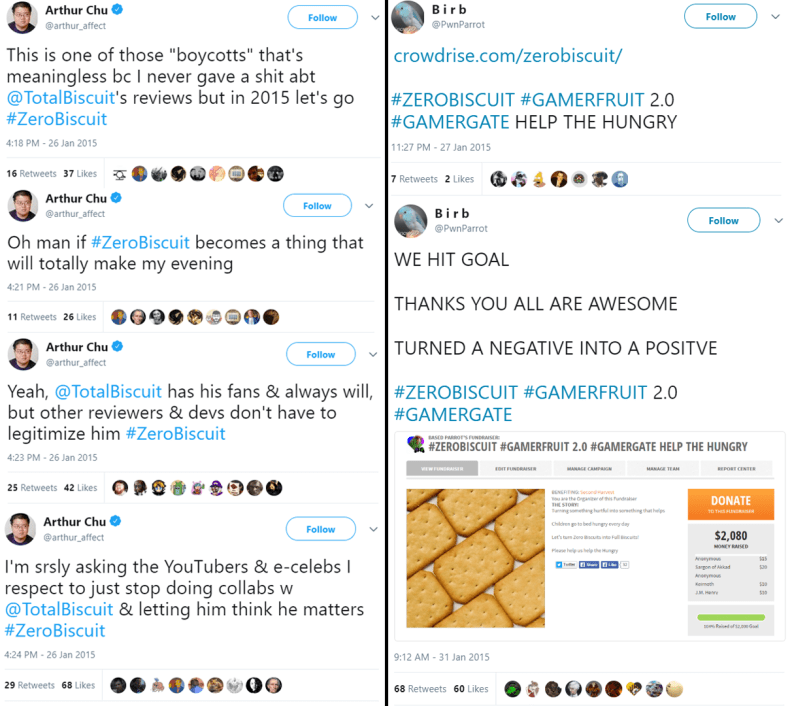

It was an intentional attack against Totalbiscuit’s reputation too, as seen by the follow-up #ZeroBiscuit hashtag that immediately followed Gallant’s smear piece against Bain. It was supposed to be a “boycott” according to the starter of it, Arthur Chu. It was geared towards stopping game developers and reviewers from “legitimizing” him. Moreover it was an attack on Totalbiscuit’s source of income and livelihood, as seen by Chu’s plea that “YouTubers & e-celebs” cut any contact and collaboration work between TB and themselves.
How did this pan out in the end?
GamerGate supporter @PwnParrot did what any gator would do back then. They turned the negativity into a positive by hijacking the #ZeroBiscuit hashtag and making it a charity fundraising effort. They started it on the evening of January 27th 2015, and gave it a nudge out into the public eye. By the morning of January 29th the effort reached the halfway point. $1000 raised to fight world hunger in under 48 hours. Two days after that on the 31st, @PwnParrot happily revealed that #ZeroBiscuit was a success. $2000 (and then some) was collected for charity.
If you want to know how that kind of turnaround is possible? Look no further than the GamerGate “harassment campaign.” Somehow, all these people got together and aspired to do something good for the world. Someone must’ve reminded them of the importance of their personal values.
SO TO REVIEW: hashtag followed by an attack on Totalbiscuit’s livelihood, followed by another hashtag. For what? Taking the piss out of game journalism.
The tragedy of all this is even though it’s blatantly a sham, the messy smear job by Gallant manages to create a snowball of negative attention in the days following it being published. The bottom line is David Gallant’s efforts to blacklist Totalbiscuit from the games industry we’re futile in of themselves. He tried it on and off again in the months afterward.
But at the end of the day, Gallant paid his dues in “shaking the beehive” of Totalbiscuit controversy.


And that was just David Gallant. All the meanwhile, you had people like the Yogscast backstabbing Totalbiscuit. Despite the fact that TB placed significant weight on his valuation of friends. On more than one occasion Bain went to bat for the Yogcast. He considered them friends and wasn’t afraid to defend them when it came to the infamous Notch feud, either. At the outset of GamerGate, TB placed special emphasis on the need to make friends with folks on the other side of the political spectrum. So for TB it was hard to see Simon throwing him under the bus. He much preferred to hash out their differences in private. The tensions were still heated a few months after their initial falling out, with Simon calling TB a “pissbaby.” Bain reacted with indifference and simply wrote Yogscast off as opportunists. All over the fact that TotalBiscuit just wanted Yogscast to give a little more disclosure. In return, they lobbed the accusation that more of Bain’s content is “paid for” than he let on.
JAMES PORTNOW IS OPPOSITE PERSONALITY OF DAVID GALLANT
— Extra Creditz January 28th 2015 http://www.twitlonger.com/show/n_1skbco2 http://www.twitlonger.com/show/n_1skam53
— 11:09 AM – 21 Feb 2015 No “Gamergate” did not threaten to Sarin gas PAX holy shit it is time to stop this insane fear-mongering. Lunacy! archive.is/pZ6y2
Totalbiscuit had his competition cut out for him. Facing off against the wit of the great Leigh Alexander, no less.

g
g
In March 2015, Totalbiscuit responded to Moviebob’s outburst about him. He accused TB of hiding, and that he was only aligned with GamerGate in order to “hurt his (superior) competitors.”


Now. Time for a little review. Here’s a July 2015 tweet from GOG.com. By now, the toxic outrage that resulted from Totalbiscuit’s GamerGate involved had several months to seep into the gaming community.
This brand-deal (in the sense that it was using Totalbiscuit’s name to sell a product) tweet shows up.


Right in the midst of GamerGate’s first full polarizing Summer.
What I want you to do is sit back and put on your thinking caps for a moment. Take a moment. Picture in your head what the replies look like. On one side, his critics. On the other, his fans. As you can imagine, the replies to the GOG tweet are clash, after clash, after clash.
February 17th 2016 BBC 3 Interviews TotalBiscuit about online harassment and gaming – Full audio https://www.youtube.com/watch?v=1y9bS5cqLaM
— How GamerGate impacted his friendships
— “It is interesting. Spent 4+ years helping indie devs wherever I can with huge exposure, yet many turned on me the last few days.” (8:58 AM – 20 Aug 2014) archive.is/fnrGj